A severely decayed or irreparable tooth
If decay has destroyed most of the tooth or its root, the tooth can no longer be rebuilt.


A painless, quick and safe procedure, even for baby teeth
Tooth extraction, also known as tooth removal, is an oral surgery procedure in which the oral surgeon or dentist removes the tooth from the jawbone. The treatment is usually done under local anesthesia; in more complex cases or on request it can also be performed under sedation or general anesthesia.
At the PureDental clinic in Budapest's 2nd district, our primary goal is to preserve your own teeth. We recommend removing a permanent tooth only when it can no longer be saved safely, or when keeping it is not advisable for other dental, oral surgical or orthodontic reasons. Every treatment is preceded by an examination and, where needed, diagnostic imaging, and you receive detailed information about your options and the expected costs.
The purpose of tooth extraction is the professional treatment of a tooth that cannot be kept or has to be removed for another reason, ending pain and the source of infection and preventing further complications. If there is a realistic chance of saving the tooth, we consider it before removing it.
The procedure is especially justified if you have:
If decay has destroyed most of the tooth or its root, the tooth can no longer be rebuilt.
If the fracture runs below the gum line down to the root, the tooth usually cannot be saved.
Persistent inflammation can also damage the bone around the root tip.
If the bone that holds the tooth has largely thinned out, the tooth cannot be kept.
In this case the removal makes room for the permanent tooth.
A tooth that sustains long-term inflammation can burden the whole body.
Sometimes there is not enough room to align the teeth, so one tooth has to be removed. We decide this together with the orthodontist.
The extra tooth can block the other teeth from coming through or from being aligned, so removing it may be justified.
If the root breaks deep down or lengthwise, the tooth cannot be fixed in place again.
If neither the root canal treatment nor a retreatment has stopped the inflammation, and an apicoectomy (root tip removal) is not advisable either, removing the tooth is what remains.

Before any extraction we always check whether there is a way to keep the tooth. This is why at our clinic extraction is the last resort.
We assess case by case, based on the examination and imaging, when a decayed tooth can no longer be saved.
Whether the tooth is removed with a simple or a surgical procedure depends mainly on the position of the tooth, the shape of the roots, the condition of the crown and the anatomy of the surrounding bone. Where needed, the examination is supplemented with a targeted X-ray or a panoramic image. In more complex cases a CBCT scan may also be necessary.
Scroll sideways to see the full table
| Aspect | Simple extraction | Surgical (open) extraction |
|---|---|---|
| When | The tooth is easily accessible and can be removed without opening the gum | The position, fracture or root anatomy of the tooth requires opening the gum |
| Instruments | Forceps, elevators and other extraction instruments | Opening the gum, sectioning the roots and removing bone as needed |
| Duration | Usually shorter, but it varies individually, a few minutes | Often takes longer, up to 30 minutes |
| Stitches | Not always necessary | Often needed |
| Healing | Mostly fewer complaints after the procedure, 4-5 days | Swelling, tenderness and longer recovery may occur, 7-10 days |
| Price (2026 price list) | €102 (single-rooted), €128 (multi-rooted) | €167 (surgical), €135 (complicated, with dissection) |
In a surgical or open extraction, the oral surgeon opens the gum where needed, creates access to the tooth or its roots and, if justified, removes the tooth in several pieces. In some cases a small amount of bone also has to be removed. At the end of the procedure the wound is closed with stitches as needed.

First we examine the tooth and the surrounding area. To assess the position of the tooth and the anatomy of the roots, a targeted X-ray or panoramic image is taken where needed. We recommend CBCT when the three-dimensional information can meaningfully help safe surgical planning.
We also ask about underlying conditions, allergies and the medicines you take. It is especially important for us to know about blood thinners, antiplatelet drugs, medicines that affect bone metabolism (used for osteoporosis or cancer) and any earlier radiation therapy.
We adapt the anesthesia to the procedure and to your health. The aim is that you do not feel sharp pain during the extraction. You may still feel pressure, tension and movement, which does not in itself mean that the anesthesia is inadequate.
If you feel pain during the treatment, tell us right away so that we can give additional anesthesia if needed.
In a simple case we remove the tooth with forceps, an elevator and other extraction instruments as needed. In a surgical case, opening the gum, separating the roots or removing a little bone may also become necessary.
After the tooth is removed, we check the socket and clean the area if needed. To stop the bleeding we place a gauze pad on the wound and, where justified, use a hemostatic material or a stitch.
At the end of the treatment you receive detailed written instructions on caring for the wound at home, eating, pain relief and the symptoms for which a check-up is needed.
If needed, we arrange a check-up. Non-absorbable stitches are usually removed after 7-10 days, but the exact time depends on the procedure and on how the wound heals. With absorbable stitches, suture removal is not always necessary.
At PureDental we provide suture removal and the related check-up free of charge.
A simple extraction is often a relatively short procedure (a few minutes), while removing a complex, surgical or multi-rooted tooth can take longer (about 30 minutes). The total time at the clinic also includes waiting for the anesthesia to take effect, the extraction itself, wound care and the instructions after the procedure.
We can give more precise information about the expected duration after examining the tooth in question.
With modern technology, experienced specialists and personalized aftercare, we make sure that the surgery is safe, quick and successful in the long term.
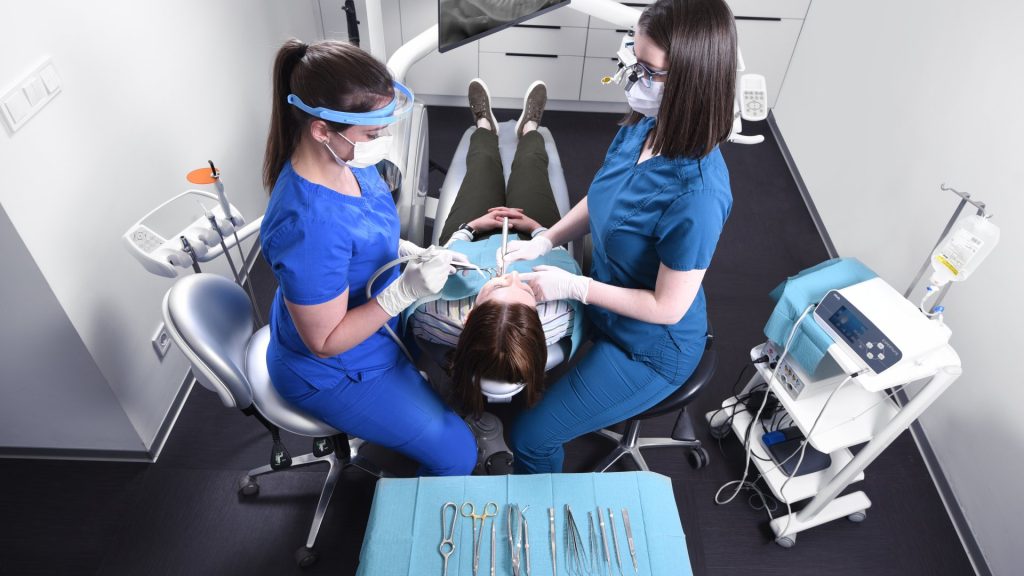
Tooth extraction is done under local anesthesia, so you generally do not feel sharp pain during the procedure. You may still feel pressure, pulling or tension. If you are very anxious, several teeth need to be removed or a more complex operation is expected, sedation or general anesthesia may also be an option.
While the tooth is being removed, thanks to the anesthesia you mainly feel pressure and movement. When the numbness wears off, the wound may become tender, and pain, tightness or swelling may appear for a few days (3-5).
The extent of the complaints after the procedure depends on how complex the procedure was and on how you heal individually. The pain relief recommended by the doctor can help you manage the discomfort.
Whether the tooth is a lower or an upper one does not in itself decide how much pain you feel. The bone of the lower jaw is usually denser, and the anesthesia technique may also differ. For the upper teeth some extractions can be simpler, but the shape of the roots, the closeness of the sinus and the condition of the tooth can affect how difficult the procedure is here as well.
With proper anesthesia, our aim in both jaws is that the treatment takes place without sharp pain.
In general, removing upper teeth is often simpler, because the structure of the upper jaw is mostly less dense, so the teeth can be moved more easily. The bone of the lower jaw is usually denser and harder, so removing some teeth may need more force or a more complex technique.
However, the difficulty of an extraction is not determined only by whether the tooth is in the lower or the upper jaw. The number and shape of the roots, the condition and position of the tooth and the closeness of the surrounding anatomical structures are at least as important. Removing an upper molar with unfavorable root anatomy, for example, can be harder than removing a lower tooth.
The dentist judges the expected difficulty of the procedure on the basis of the clinical examination and, where needed, an X-ray.
Sedation or general anesthesia is recommended for those who are very afraid of the treatment, who need several teeth removed at once, or whose procedure is more difficult. Both tooth extraction under general anesthesia and under sedation are available at our clinic. We choose the suitable method on the basis of your health, the surgical plan and anesthesiological considerations.
Details: Anesthesia and sedation.
Before the extraction, tell us about every medicine you take regularly and every known condition. It is especially important if you take a blood thinner or an antiplatelet drug, have diabetes or a bleeding disorder, have had head and neck radiation therapy, or take a bisphosphonate, denosumab or another medicine affecting bone metabolism because of osteoporosis or cancer.
Do not stop your blood thinner on your own decision. In many cases the extraction can be done while you continue the medicine; in other cases the timing of the dose or further testing is needed. The dentist or oral surgeon performing the procedure decides this on the basis of the medicine used, the bleeding risk and, where needed, consultation with your treating physician.
If you are pregnant, tell us this already when you book your appointment. Justified dental treatments, especially those that stop pain or infection, do not have to be postponed automatically during pregnancy either.
If you have questions about treatment during pregnancy, we are happy to advise you in person.
At PureDental, a tooth extraction costs €102 for a single-rooted tooth, €128 for a multi-rooted tooth and €167 for a surgical extraction. The price depends on the type of tooth and on how difficult the procedure is.
The exact cost is determined by the position of the tooth, the anatomy of the roots, how difficult the procedure is and any additional diagnostics or type of anesthesia that may be needed.
The prices are shown for information, based on the price list published on the PureDental website. Before any treatment we always give you an exact quote.
At the PureDental clinic you can pay for dental and oral surgery treatments in cash, by bank card or by prior bank transfer.
The cost of the treatments may also be eligible for settlement with a health fund. For details, see our page on health funds.
For our pensioner patients we provide a 10% discount under its current terms.
*Discounts cannot be combined.
The full price list can be found in the PureDental price list.

You can eat and drink 2-3 hours after the anesthesia wears off; in the first days choose lukewarm, soft foods.
The bleeding of the wound stops with a clot forming, and mild swelling and tenderness appear.
The swelling is usually strongest at this point, and the pain gradually eases.
The gum begins to close over the wound. If there are stitches, this is when they are removed.
The surface of the wound heals. The remodeling of the bone can take longer, even months.
We go through the details again in the written aftercare instructions you receive after the procedure.

Mild pain, swelling and some bleeding are normal in the first days after an extraction. The signs of an infection after tooth extraction, however, mean more than that. In that case do not wait, call us, and in an urgent case contact our emergency dental care:
If the swelling spreads quickly toward the neck or throat, or you have difficulty swallowing or breathing, immediate emergency care is needed. In case of breathing difficulty, call 112.
A dry socket, also called alveolitis, is a painful complication that can develop after tooth extraction. It can appear when the blood clot that forms in the socket breaks down or disappears too early, and the surface of the bone is partly exposed.
It is characterized by severe pain, often radiating toward the ear, which typically starts or gets worse in the first few days after the extraction. An unpleasant taste or bad breath may also accompany it.
A dry socket is not necessarily a bacterial infection, so it is not always treated with antibiotics either. With dental care the complaints can usually be eased, so if the pain gets stronger, ask for a check-up as soon as possible.
If you are unsure whether your symptoms are normal, call us.

After a tooth is removed, in many cases it is worth planning the replacement of the missing tooth. This matters not only for looks: a missing tooth can affect chewing, the bite, the position of the neighboring teeth and, in some cases, speech as well.
Not every removed tooth has to be replaced. For wisdom teeth, for example, no replacement is needed. For other missing teeth we weigh up the need for a replacement based on the situation
In certain cases a dental implant can be placed in the same visit as the extraction. This requires suitable bone conditions, a favorable socket anatomy, a safe implant position and adequate primary stability.
An active, acute infection can be an unfavorable condition for immediate implantation. An earlier or chronic lesion at the root tip, however, is not always a reason to rule it out, if the infected tissue can be removed properly and the necessary anatomical conditions are met.
In other situations it is more advisable to wait for the wound to heal, do bone grafting if needed, and place the implant at a later date.
We make the decision on the basis of the clinical examination and, where justified, CBCT-based planning.
If an implant is not possible, or the patient prefers another solution, in some cases the missing tooth can also be replaced with a dental bridge or a removable prosthesis.
In the case of larger or complete tooth loss, a removable prosthesis supported by implants, for example a bar-retained denture, may also be an option.
We present the options in detail on our dental prosthetics and dental implants page.
After the tooth is removed, the natural remodeling of the socket and the surrounding jawbone begins. During this process both the width and the height of the bone may decrease.
If there is not enough bone for a later implant, bone grafting may be needed. In some cases a bone-preserving treatment done at the same time as the extraction, so-called socket preservation, can help reduce later bone loss.
It is therefore worth talking about the planned implant already before the extraction.
Removing a wisdom tooth can be a simple extraction, but in some cases it is a procedure that needs surgical opening. If the tooth lies partly or fully in the bone, grows at an angle or is close to important anatomical structures, especially careful planning is needed.
We write about the indications for removing wisdom teeth, the surgical options and the healing on a separate service page.
Details: Wisdom tooth removal
For many patients tooth extraction comes with anxiety, especially if they have lived through a painful treatment before or need a more complex oral surgery procedure.
At PureDental we work with modern diagnostics, local anesthesia, the option of sedation or general anesthesia where needed, and personalized aftercare, so that the treatment is as gentle as possible.
Our clinic also has dentoalveolar surgical expertise available for the care of more complex extraction and oral surgery cases.
The professional content of this page was reviewed by Dr. Nóra Boka, dentoalveolar surgeon.
At the PureDental clinic both panoramic X-ray and 3D CBCT diagnostics are available. We use them where justified to assess the position of the roots, the anatomy of the jawbone and the closeness of the nerve canal or the sinus.
Suitable imaging can help assess surgical risks and plan the procedure more precisely.
The check-up after the operation and the necessary suture removal are an important part of aftercare. At our clinic we provide the related suture removal and check-up free of charge, so that you can also come to us with confidence with any questions that come up during healing.
We have collected the questions that our patients ask most often before and after a tooth extraction.
 Professionally reviewed by Dr. Nóra Boka Dentoalveolar surgeon, implantologist
No, with local anesthesia a tooth extraction does not hurt. Thanks to our modern, special anesthetic it is completely painless, and during the procedure you may feel pressure and pulling. After the numbness wears off the wound may be tender for a few days. If you are very afraid, you can also ask for sedation or general anesthesia; we discuss this at the examination.
You can eat and drink about 2 hours after the anesthesia wears off. In the first days we recommend soft foods; avoid chewing on the affected side. Choose lukewarm food and drinks, and avoid hot, spicy or hard bites. You also receive the detailed information in written instructions.
In a simple extraction the tooth can be removed with the right instruments without opening the gum. In a surgical extraction, opening the gum, separating the roots or, if needed, removing a little bone may also be involved.
We determine the right procedure on the basis of the clinical examination and the necessary X-ray diagnostics. CBCT is not needed in every case.
Yes. After healing we restore the gap with an implant, a bridge or another modern dental prosthesis. In some cases the implant can be placed at the same time as the extraction, if there is no inflammation and there is enough bone. It is worth discussing the method of replacement before the extraction as well.
The extraction site is usually most tender in the first 2-3 days, after which the pain gradually eases. The temporary tenderness is a natural part of healing. If the pain does not ease after three days but gets stronger, it can point to a complication, for example a dry socket; in that case come and see us.
Bleeding after an extraction can be mild in the first hours, which is natural. Biting on a gauze pad usually stops it. A pinkish tint in the saliva may still occur on the first day. If the bleeding does not stop even after biting on gauze, do not wait, call us; the clinic can also be reached by phone during opening hours.
Avoid smoking and alcohol for at least 3 days after the extraction, because they slow healing and increase the chance of a complication. Drink coffee lukewarm, after the time given for eating. Hot drinks and foods can irritate the wound in the first days, so in the first days rather drink something lukewarm.
Our recommendation on dairy products: avoid them for 3-4 days after an extraction. In the first days choose lukewarm, soft foods, and avoid hot, spicy or hard bites, especially on the affected side. This helps the wound heal in peace. If you are unsure, call us; during aftercare we are also available by phone.
If a piece of root may have been left in the wound after an extraction, have it checked with an X-ray. A small root fragment without symptoms is sometimes left in on purpose if removing it would carry a greater risk near a nerve or the sinus. A piece that causes inflammation must be removed. If you have pain, swelling or a bad taste, come and see us so that we can treat it in time.
Pulling a tooth at home is dangerous because without sterile conditions, anesthesia and an X-ray the root can easily break, the bone, the nerve or the gum can be damaged, and a serious infection can develop. Even a loose tooth holds on to the bone with its root. If your tooth is loose or hurts, see a dentist.
How many teeth can be pulled in one visit depends on the condition and position of the teeth and on your general health. Several teeth can be removed at once, and in that case we often work under sedation or general anesthesia. We prepare the exact plan on the basis of the X-ray and the examination.
Yes, if needed an extraction can also be done during pregnancy, but only after weighing it up with a specialist. Removing a tooth without symptoms is usually postponed until after the birth, but an inflamed, painful tooth should not be put off. Tell us about the pregnancy already when you book your appointment, so that we can plan the treatment accordingly.
In many cases yes. Treatment with a blood thinner or an antiplatelet drug does not in itself mean that an extraction cannot be done.
What needs to be done depends on which medicine you take, how great the expected bleeding risk of the procedure is and what other conditions you have. For certain medicines, recent lab results, for example an INR test, may also be needed.
Never stop or change your medicine on your own decision. Before the procedure we agree on the necessary steps.
An antibiotic is not needed after every extraction. For a healthy patient, after an uncomplicated extraction, routine antibiotic treatment is generally not necessary.
An antibiotic can become justified if there is a spreading infection, general symptoms or certain health risk factors. In the case of certain conditions, antibiotic prophylaxis may also be needed before a dental procedure.
Take an antibiotic only as instructed by a doctor. Do not change the dose or the duration of treatment on your own; if a side effect appears or you have a question, consult your treating doctor.
If your tooth hurts badly, has broken or is loose, or you have been told before that it cannot be saved, request an appointment at the PureDental clinic in Budapest. During the examination we assess whether there is a way to keep the tooth, and if removal is necessary, we plan the procedure best suited to your condition.
With modern anesthesia, gentle surgical techniques and personalized aftercare, we aim to make the treatment as comfortable as possible.
Professional reviewer: Dr. Nóra Boka, dentoalveolar surgeon, implantologist. Dr. Nóra Boka is an oral and jaw surgeon and implantologist with wide experience in oral surgery, bone grafting procedures, aesthetic soft tissue surgery and periodontology.
View profile