Teeth replaced
01One tooth missing


A dental implant can offer a natural-looking, stable and long-term solution for replacing one or more missing teeth. It can help you speak with confidence again, eat comfortably and smile freely.
At PureDental's clinic in Budapest's 2nd district, we create personalised implant-supported restorations using premium implant systems, digital planning based on 3D CBCT imaging and a gentle procedure under local anaesthesia.
Request an appointment for an implant consultation!A dental implant is an artificial tooth root placed in the jawbone that can provide a stable foundation for a crown, bridge or full set of replacement teeth. It can be a good solution if one or more teeth are missing, if we would rather not grind down the healthy neighbouring teeth, or if a more stable, more comfortable restoration is needed in the case of complete tooth loss.
Before treatment, we assess the jawbone, the bite, the anatomical conditions and any need for bone grafting using 3D CBCT diagnostics.
A dental implant is an artificial tooth root made of titanium or zirconia, which we place in the jawbone. During healing, the implant fuses with the surrounding bone and can serve as a stable foundation for the restoration built on top of it.
One of the greatest advantages of a dental implant is that it replaces the root of the missing tooth on its own, so in some cases grinding down the healthy neighbouring teeth can be avoided.
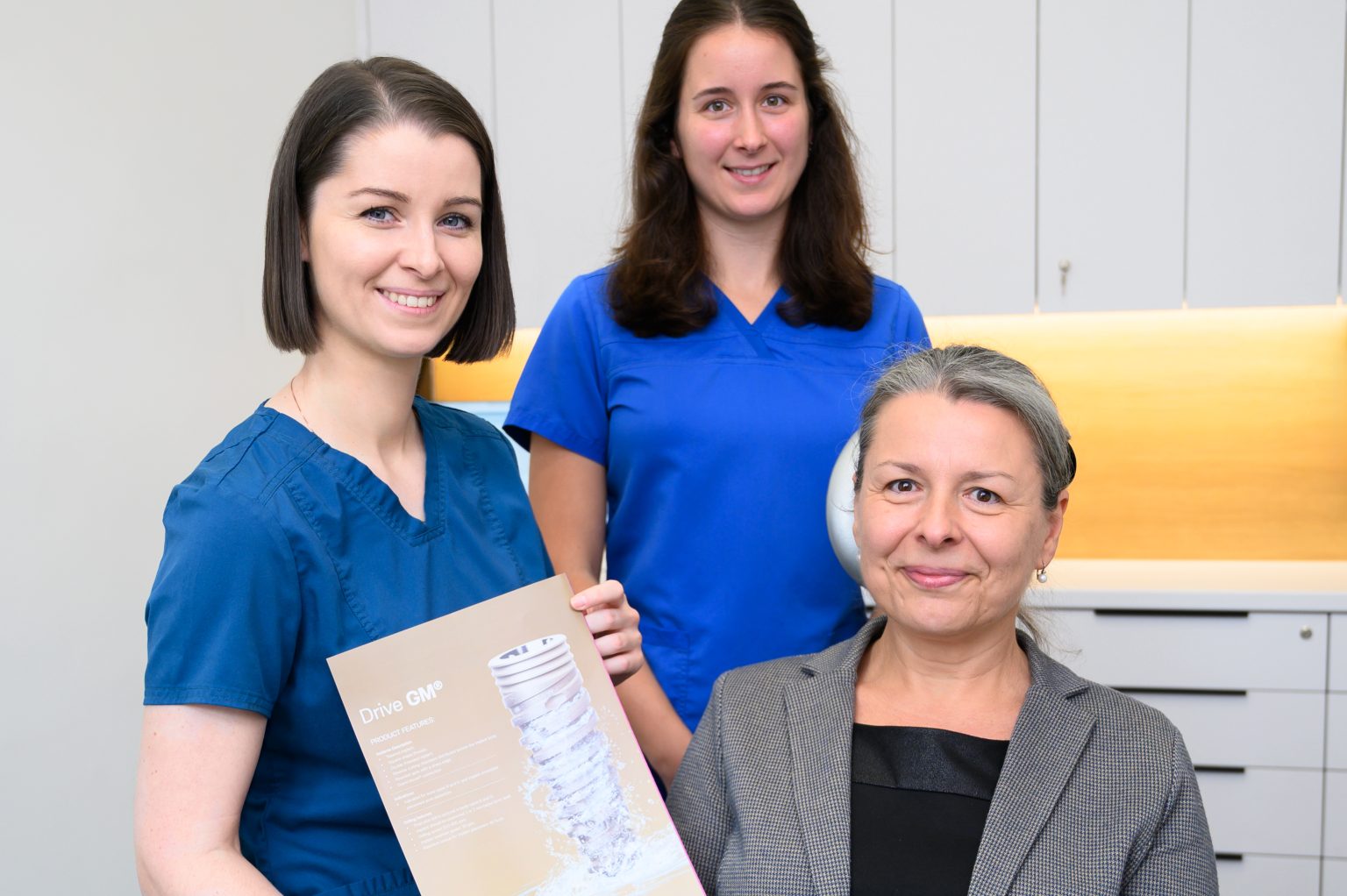
In our clinic we work with the internationally recognised Straumann® and Neodent® implant systems. These are modern, reliable systems that can provide a stable foundation for a single crown, a bridge or even a full arch of teeth.
The right implant system is always chosen on the basis of the individual bone condition, the type of restoration, aesthetic requirements and the long-term treatment plan.
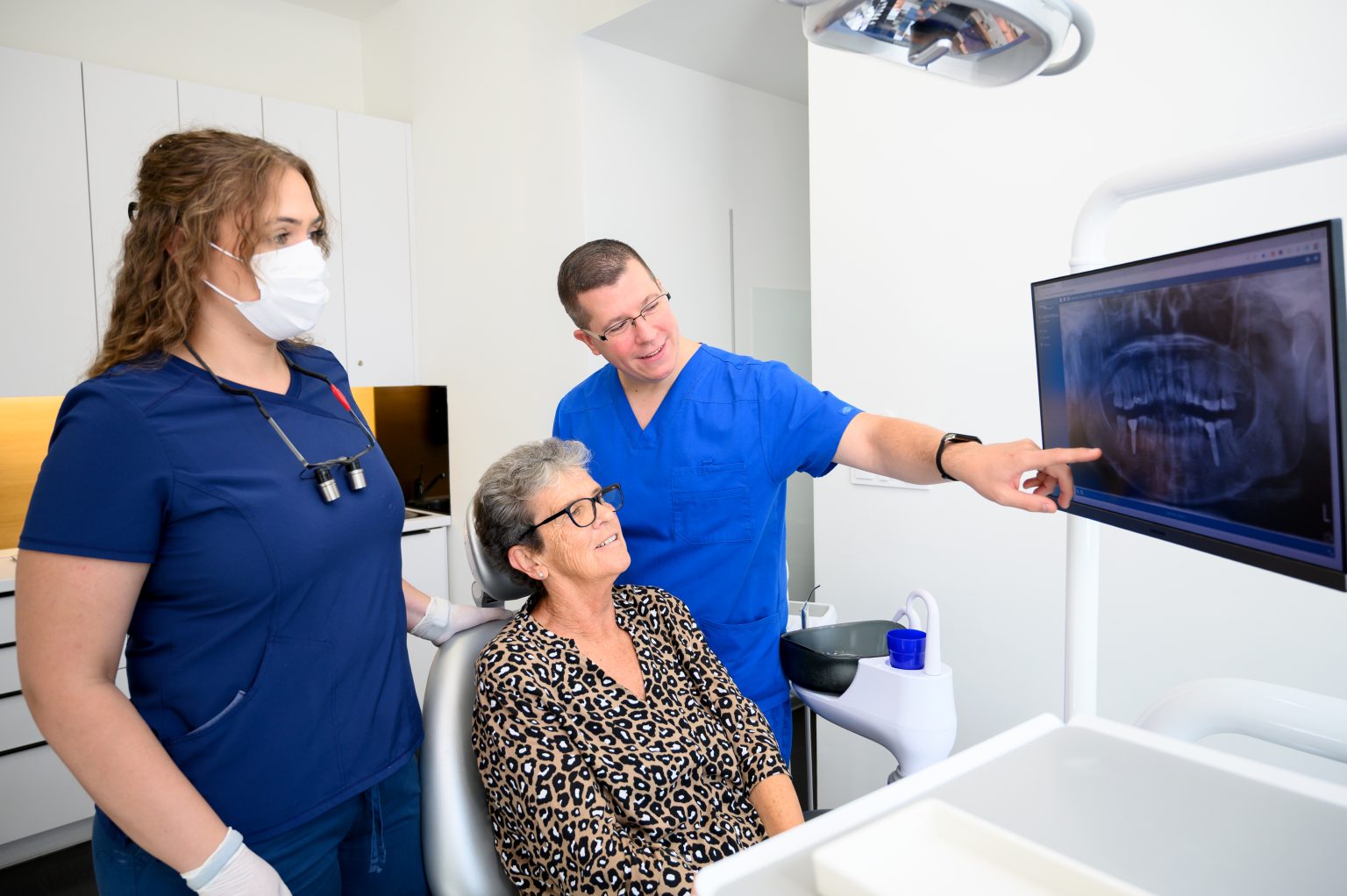
When planning a dental implant, we use a 3D CBCT scan to examine the shape of the jaw, the amount of bone available, and the position of the nerves, the maxillary sinus and other surrounding anatomical structures.
The aim of digital planning is for the implant to be placed in the safest and most favourable position possible, taking into account the aesthetic and functional aspects of the future restoration as well.
With a proper indication, precise planning, good oral hygiene and regular check-ups, a dental implant can be a long-term, stable tooth replacement solution.
The purpose of the implant is to replace the root of the missing tooth and to provide a secure foundation for the crown, bridge or full-arch restoration placed on top of it.
Dental implant placement is carried out under local anaesthesia, so the patient does not feel sharp pain during the procedure. We perform the treatment with a gentle surgical technique, and on request general anaesthesia or sedation may also be an option.
After the operation, swelling, tightness or mild pain may occur for a few days, which can usually be managed well by following the instructions given.
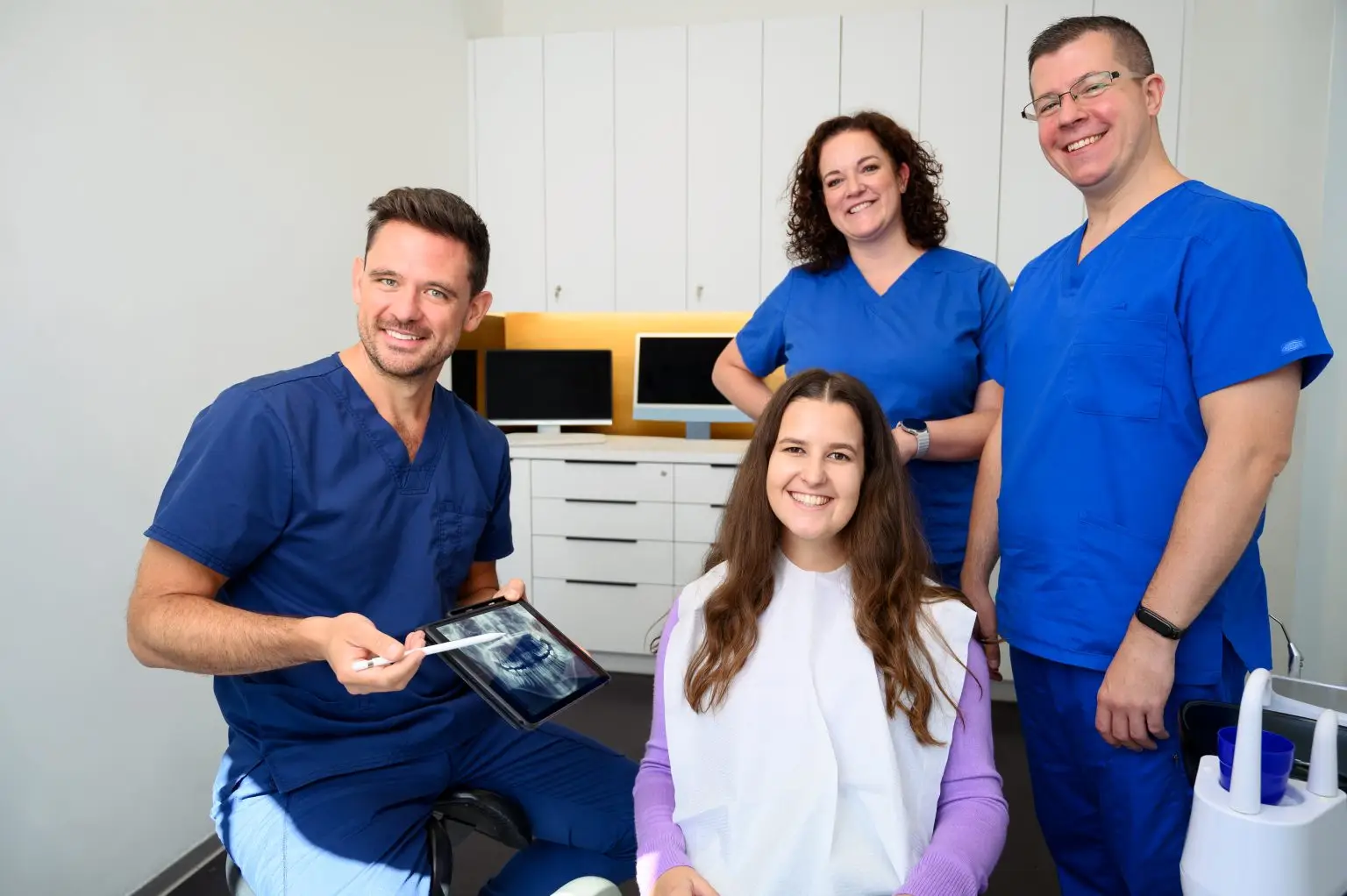
A dental implant can be an ideal choice for anyone who wants to replace a missing tooth or teeth and is looking for a tooth replacement that is stable, comfortable and natural-looking in the long term.
It may be particularly recommended if you:Dental implantation can be a safe procedure with a high success rate, but it cannot always be carried out straight away. In certain conditions, a preliminary assessment, additional treatment or bringing your general health under control is needed so that the implant can be placed in a stable, healthy environment.
In the case of uncontrolled diabetes or another chronic condition that affects healing, the underlying condition must first be properly managed. Well-controlled diabetes is not necessarily an obstacle in itself, but blood sugar control is an important part of the risk assessment.
In the case of heavy smoking, healing may be slower and the risk of inflammatory complications and of bone loss around the implant may be higher. That is why we recommend significantly reducing or stopping smoking both before and after the procedure.
In the case of insufficient bone volume, the implant cannot always be placed safely without preparation. In such cases, bone grafting, a sinus lift or other preparatory implant treatment may be needed.
In the case of untreated gum disease or periodontitis, the inflammation must be treated first. For the long-term success of the implant, it is essential that the surrounding gum and bone are stable and free of inflammation.
In the case of certain medications, previous radiotherapy or diseases affecting bone metabolism, an individual risk assessment is required. In such cases, we always determine the treatment plan on the basis of your general health, your medication and the dental diagnosis.
None of these automatically means that you are not suitable for a dental implant. In most cases, it is rather that thorough diagnostics, preparation or closer aftercare is needed before the procedure.
At PureDental, 3D CBCT diagnostics, a detailed consultation and a personalised treatment plan help us to choose a safe solution that is stable in the long term.
Dental implantation begins with precise diagnostics and digital planning. This is followed by placing the implant under local anaesthesia with a gentle surgical technique. After the healing period, we make the final crown, bridge or full-arch restoration, which delivers a stable and natural-looking result.
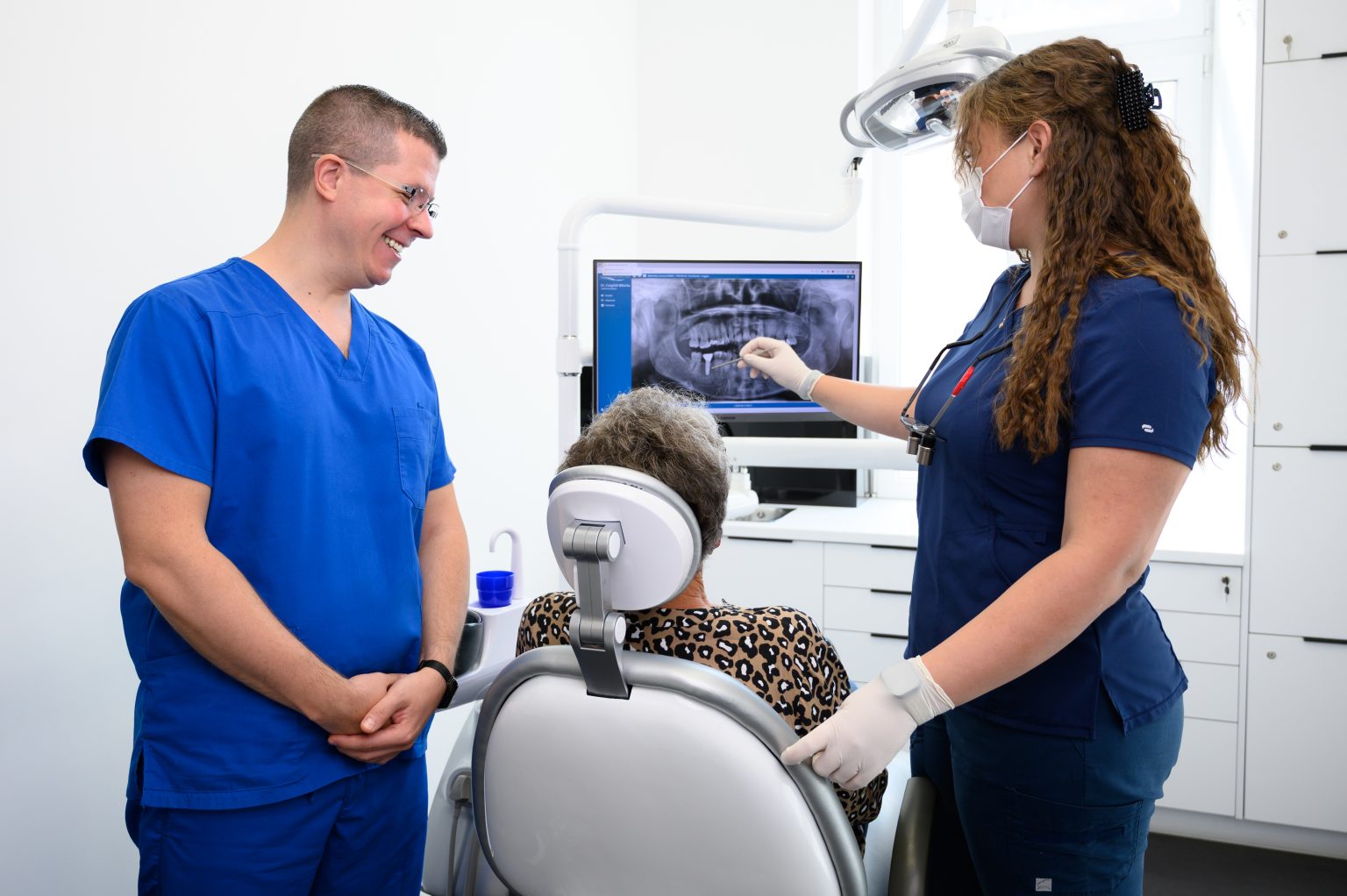
Diagnostics, 3D planning and implant placement
The first step of the treatment is a detailed assessment of your condition. Using a 3D CBCT scan and an oral examination, we assess the condition of the jawbone, the amount and quality of the bone, the position of the nerves and the maxillary sinus, and the condition of the existing teeth and gums.
Based on this, we prepare a personalised treatment plan that sets out the number, position and type of implants, any need for bone grafting, and the options for the final restoration.
During digital planning, we determine the ideal position, direction and size of the implant in advance. We look not only at where the implant can be placed, but also at whether the future crown, bridge or full-arch restoration will end up in a position that is right both aesthetically and functionally.
This is especially important when replacing front teeth, in full-arch rehabilitation, in cases combined with bone grafting, and in situations where the proximity of anatomical structures calls for extra care.
The implant is placed under local anaesthesia, so the patient does not feel sharp pain during the procedure. We perform the treatment with a gentle surgical technique, in line with the digital plan. If the implant is sufficiently stable at placement, in most cases we fit a gingiva former (healing abutment) so that the gum is shaped at the same time as the bone heals. If this is not possible, we close the implant with a cover screw and the bone heals under the gum. In this case, once healing is complete, the implant has to be uncovered, and by fitting a gingiva former we shape the gum and prepare it for the prosthetic treatment.
If you wish, and for larger procedures, general anaesthesia or sedation may also be an option. We always decide on this after a preliminary consultation and medical assessment.
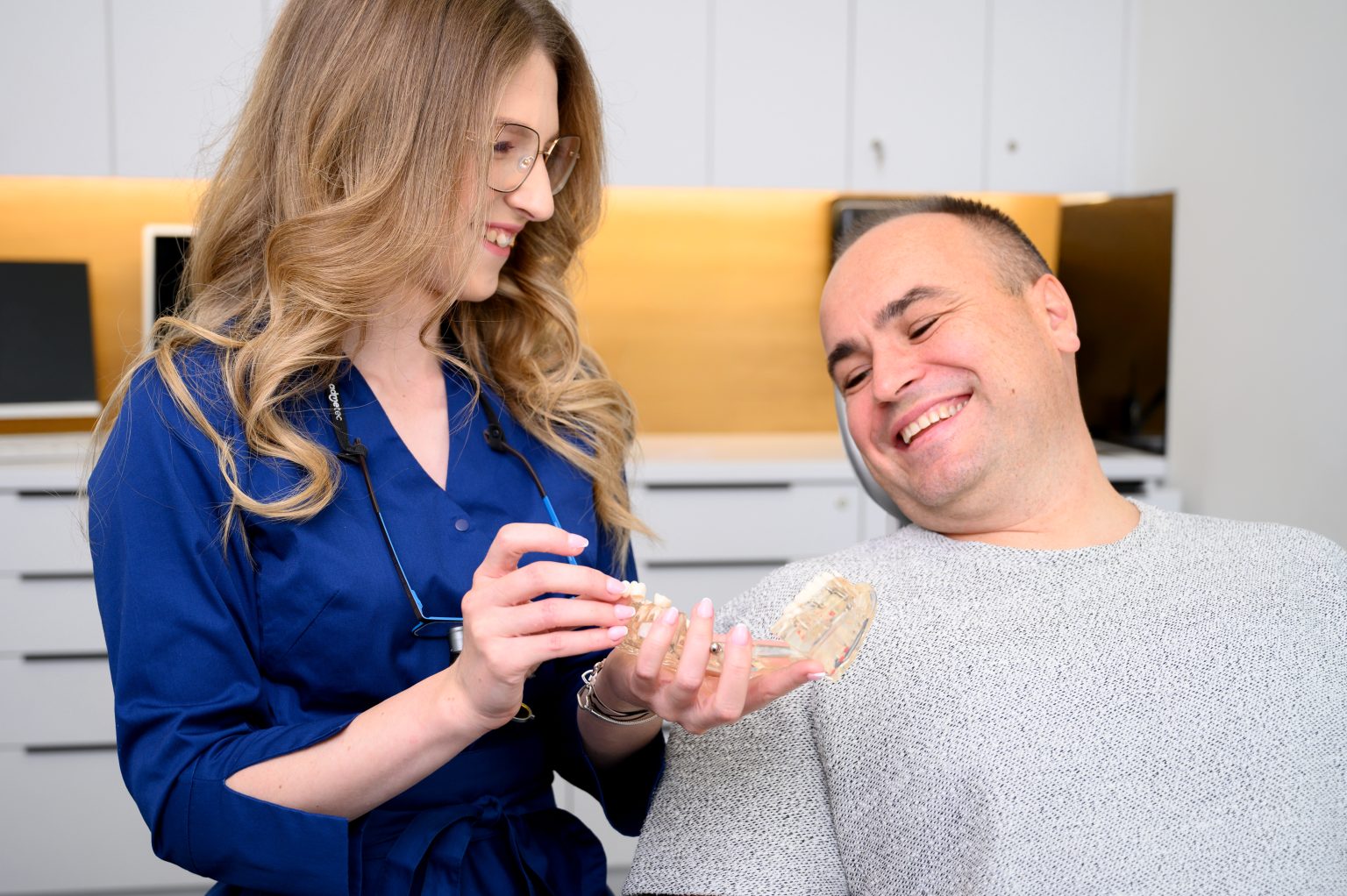
Bone integration, gum shaping and final restoration
After the implant is placed comes a healing period, during which the implant gradually fuses with the surrounding bone. This process is called osseointegration.
The healing period is usually 3–6 months, but the exact duration depends on the bone quality, the location of the implant, any bone grafting and the individual healing process.
When the implant is placed, the surgeon always checks its primary stability. If the implant is already sufficiently stable at placement, we usually fit a gingiva former straight away. This helps the gum around the implant to take on its natural shape, so that the later crown or bridge can fit the gum in a more aesthetic and harmonious way.
If the implant does not have sufficient primary stability at placement, we choose submerged (closed) healing: we let the implant heal under the gum so that it can integrate with the bone in a protected environment. When the healing period is over, we uncover the implant with a minor procedure and then fit a gingiva former.
Once the gum has shaped properly, we take an impression or a digital scan, on the basis of which the dental laboratory makes the final crown, bridge or implant-supported restoration.
After the healing period, we make your final crown, bridge or full-arch bridge. The aim is for the restoration to be stable, to blend naturally into your smile, to withstand chewing forces well and to function comfortably in the long term.
When the final restoration is fitted, we also check the bite, the aesthetics, how easy it is to clean and the patient's comfort.
The type of restoration on the implant depends on whether a single tooth, several teeth or a full arch needs to be replaced. We always choose the right solution on the basis of the extent of tooth loss, the bone available, the bite, aesthetic needs and the patient's expectations.
When a single tooth is missing, a stand-alone crown is made on the implant. The advantage is that the neighbouring teeth do not have to be ground down, as they would be when making a conventional bridge.
This is especially beneficial if the teeth next to the missing tooth are intact, healthy and do not need a crown.
When several adjacent teeth are missing, it is not necessarily required to place a separate implant for each missing tooth. In some cases, a bridge fixed to several implants can replace the missing teeth stably.
We always determine the exact number of implants on the basis of the length of the gap, the bone available and the type of restoration planned.
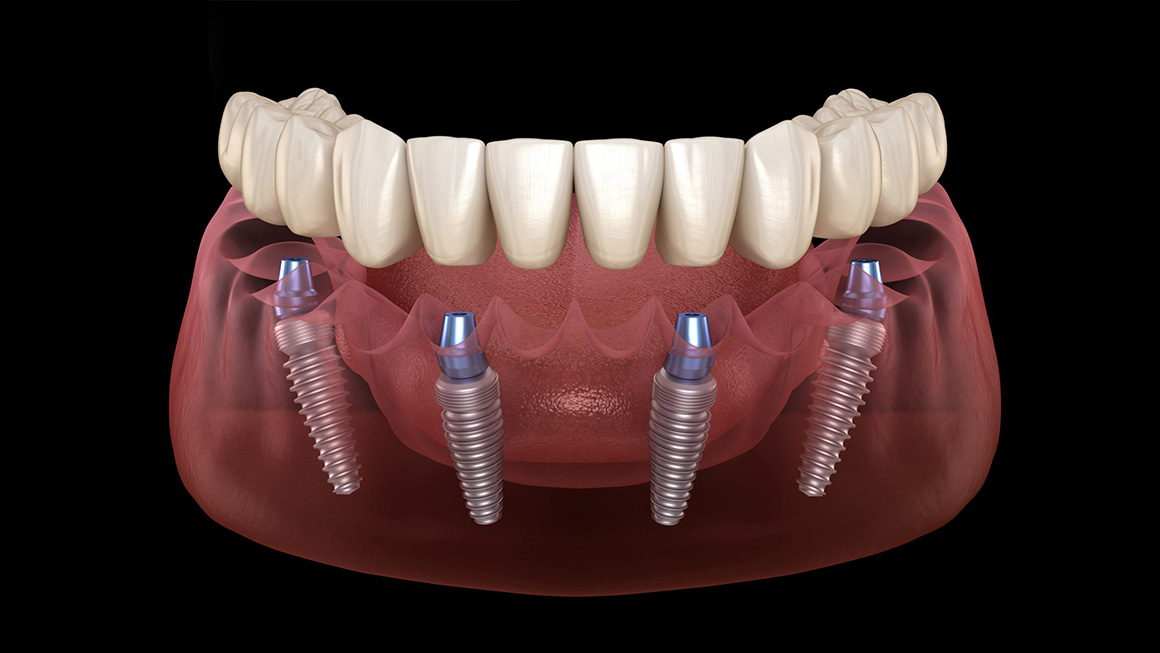
In the case of complete tooth loss, an All-on-4™ restoration can be a modern, fixed-type solution. The essence of the technique is that a full arch of teeth is fixed on four implants.
In many cases it can also be a solution when the patient has worn a removable denture for a long time or wants a more stable, more comfortable restoration. Read more →

A bar-retained denture is a restoration that is anchored to implants yet remains removable. It can provide a more stable hold than a conventional removable denture, while the patient can still take it out for cleaning.
This solution can be particularly beneficial when a fully fixed full-arch bridge is not ideal but a conventional denture no longer provides enough comfort or stability.

In the case of partial tooth loss, a partial denture may in certain situations also be made. This can be a more budget-friendly solution, but in terms of stability and comfort it generally differs from restorations fixed on implants.
At the consultation, we discuss every possible solution so that you can clearly see the advantages, the limitations, the duration and the expected costs.
Dental implants can be classified in several ways: they can be made of different materials, they can differ in structure, and they can belong to different manufacturers' systems.
For the patient, the most important question is usually how stable a given implant is, how well documented it is, what kind of restoration can be made on it, and what long-term security it offers.
In modern implantology, we most often use two-piece implant systems. In this case, the implant body placed in the jawbone and the abutment connected to it form separate units.
This gives greater flexibility in planning the restoration, because a different solution may be needed for a single crown, a multi-unit bridge or a full arch.
With a one-piece implant, the implant body and the abutment form a single unit. This is a less commonly used solution today and is more likely to come into question in special clinical situations.
In most modern cases that are more complex aesthetically and prosthetically, a two-piece implant system offers greater planning freedom.
Most dental implants are made of titanium, because titanium is well documented, biocompatible and has long been used in implantology. In certain cases a zirconia implant may also be an option, for example on the basis of special aesthetic or material considerations.
The choice of implant material always requires individual consideration.
At PureDental, we work primarily with Straumann® and Neodent® implant systems.

Straumann® is a Swiss premium system known worldwide for its long clinical track record and advanced surface technology.

Neodent® is also an internationally recognised implant system that can offer a reliable solution at a favourable price-to-value ratio.
The choice is not only a question of brand name. We also take into account the bone condition, the type of tooth loss, the aesthetic zone, the planned restoration, any need for bone grafting and the patient's budget.
At the consultation, we always discuss which system may be the most suitable in the given situation.
The price of a dental implant depends on several factors, so an exact quote can only be given after a personal examination and 3D CBCT diagnostics. A single implant costs something different from a complete implant-supported restoration, which may also include an abutment, a crown, a bridge, a full-arch restoration, bone grafting or a sinus lift.
It is important to know that the price of the implant alone is not always the same as the final price of the complete restoration.
Implant, abutment and crownIndicative prices based on our price list: one Neodent® implant €504, one Straumann® implant €837. The abutment (Neodent® €193, Straumann® €311) and the crown on the implant (metal-ceramic €321, zirconium €407) are charged in addition; if bone grafting or a sinus lift is needed, their fees are added as well. We give the exact amount in a written quote after the examination and 3D CBCT diagnostics.
At PureDental, during the consultation we always provide a personalised treatment plan and a written quote, so that it is clear exactly what steps the treatment consists of, how long it takes and what costs to expect.
→ You can find our detailed price list here: puredental.hu/en/prices/
If the implant has healed under the gum during the healing period, once the bone has integrated we expose the upper part of the implant with a minor procedure.
At this point we fit a gingiva former, which helps the gum around the implant take on a more natural, more aesthetic shape before the final restoration is made.
In the back area of the upper jaw, it is common for tooth loss to leave too little bone height, and because of the proximity of the maxillary sinus the implant cannot be placed safely without preparation.
In such cases, an open sinus lift, that is, raising the floor of the sinus, may become necessary. During the procedure we carefully lift the lining of the maxillary sinus and then fill the prepared area with bone graft material.
Video: After Sinus Lift: Recovery InstructionsA closed, or internal, sinus lift is a smaller-scale sinus lift that in some cases can be carried out together with preparing the implant site.
It comes into question when only a small increase in bone height is needed. We always choose the right technique on the basis of the CBCT scan and the individual anatomical conditions.
Video: After Sinus Lift: Recovery InstructionsIf there is not enough bone in the jaw to place the implant safely, bone grafting may be needed. This can be done at the same time as implant placement or, in the case of greater bone loss, as a separate surgical step.
The aim of bone grafting is to provide adequate stability and a safer long-term foundation for the implant.
Video: Bone Grafting Before Dental Implants: What You Should KnowWe have collected the questions that our patients most often ask about dental implants, implant placement and implant-supported restorations.
 Reviewed by Dr. Nóra Boka Specialist dentoalveolar surgeon, implantologist
Dental implant placement can be recommended when one or more teeth are missing and the patient wants a stable, long-term and natural-looking restoration. With a single missing tooth, the advantage of the implant is that the healthy neighbouring teeth do not have to be ground down, as they would be when making a conventional bridge.
If several teeth or all teeth are missing, a bridge fixed on implants, a full-arch bridge, an All-on-4™ restoration or a bar-retained denture can also be made.
 Start video
Dental implant placement is carried out under local anaesthesia, so the patient does not feel sharp pain during the procedure. For many patients, the treatment is less burdensome than they feared beforehand.
After the operation, swelling, tightness, mild pain or bruising may occur for a few days. These are usually normal post-operative symptoms and can be managed well by following the instructions given and, if needed, with painkillers.
After implant placement, 3–6 months are usually needed for bone integration, that is, osseointegration. During this time the implant gradually becomes firmly anchored in the surrounding bone.
The exact healing time depends on the location of the implant, the bone quality, any bone grafting, the patient's general health and their individual healing ability.
The final crown, bridge or full-arch restoration can usually be made after the implant has integrated with the bone. This most often means a healing period of 3–6 months, but in some cases a different protocol may also come into question.
Before the final restoration is made, we check the stability of the implant, the condition of the gum and the exact planning conditions for the restoration.
In many cases, yes. Whether a temporary restoration is possible depends on how many teeth are missing, which area is involved, what the bone situation is, what implant solution is being made, and whether the implant can be loaded immediately.
In the aesthetic zone or when replacing a full arch, it is especially important that the patient is not left with an unacceptable gap during the healing period. We discuss the options in detail at the consultation.
In certain cases, yes. Immediate implant placement means that the implant is placed in the same session after the tooth is removed.
This can only be recommended if the bone available, an inflammation-free environment, the condition of the gum and the anatomical conditions allow it safely. If the area is infected, there is little bone or more extensive preparation is needed, delayed implant placement may be safer.
No. If enough bone of adequate quality is available in the jaw, the implant can in many cases be placed without bone grafting.
Bone grafting may be needed if the tooth has been missing for a long time and the bone has receded, if bone loss has developed due to earlier inflammation or gum disease, or if there is not enough bone height in the back area of the upper jaw because of the proximity of the maxillary sinus.
The aim of bone grafting is to provide a more stable foundation for the implant. The exact decision is always made on the basis of a 3D CBCT scan and a personal examination.
If there is not enough bone to place the implant safely, bone grafting or a sinus lift may be needed. The aim of bone grafting is to create a stable foundation that supports the implant properly in the long term.
In the case of a smaller bone defect, bone grafting can in some cases be carried out at the same time as implant placement. With greater bone loss, a separate bone grafting procedure and a longer healing period may be needed.
A dental bridge rests on the natural teeth next to the gap, so the neighbouring teeth usually have to be ground down. A dental implant, by contrast, works as a stand-alone artificial tooth root in the jawbone and does not require the healthy neighbouring teeth to be prepared.
If the neighbouring teeth are healthy, an implant can be the solution that preserves more natural tooth structure. If, however, the neighbouring teeth already need crowns, a bridge may in some cases also be a logical choice. The decision is always made on the basis of an individual examination.
Both are good-quality, internationally recognised implant systems. Straumann® is a Swiss premium system with a long clinical track record and advanced surface technology. Neodent® is also a reliable, widely used system, with a more favourable price-to-value ratio.
When choosing, we take into account not only the brand but also the bone condition, the type of tooth loss, the planned restoration, aesthetic needs, any need for bone grafting and the patient's financial options.
A dental implant may be possible even if you smoke, but smoking can increase the risk of wound-healing problems, inflammatory complications and bone loss around the implant.
That is why we recommend significantly reducing or stopping smoking both before and after implant placement. In the case of heavy smoking, we discuss the risks separately, and closer follow-up and more thorough periodontal preparation may be needed.
Yes, in many cases you can, but it is not ideal to place an implant if you have untreated or active gum disease. The inflammation must be treated first and the condition of the gum and bone stabilised, and only then can the implant treatment be planned.
Earlier gum disease calls for extra care, because the tissues around the implant can also become inflamed. That is why regular check-ups, professional cleaning and careful oral care at home are especially important.
With good oral hygiene, regular check-ups, a stable bite and healthy tissues around the implant, a dental implant can be a long-term solution that lasts for decades.
It is important to know, however, that an implant is not maintenance-free either and should not automatically be regarded as a lifelong solution. The lifespan of an implant is affected by the patient's general health, smoking, a tendency towards gum disease, oral hygiene, bone quality, the load on the restoration and attending regular check-ups.
The crown, bridge or full-arch restoration placed on the implant may need replacing over time because of wear, damage or aesthetic reasons.
Yes. Dental implantation is a safe, routinely performed surgical procedure, but like any surgical treatment, it can carry risks.
Temporary pain, swelling, bruising, delayed wound healing, infection, altered sensation, sinus complaints, loss of the graft in the case of bone grafting and, rarely, inadequate integration or loosening of the implant may occur.
The risk may be increased by untreated gum disease, inadequate oral hygiene, heavy smoking, uncontrolled diabetes, certain medications, heavy teeth grinding and the patient not attending regular check-ups.
Precise 3D planning, a sterile surgical environment, choosing the right implant system, careful surgical technique and regular aftercare play an important role in reducing the risks.
Just as important, however, is the patient's cooperation: proper oral care at home, attending check-ups and avoiding smoking can contribute significantly to the long-term success of the implant.
After the procedure, it is important to follow the instructions given precisely. During the healing period, you should avoid smoking, alcohol, strenuous physical activity, and touching the wound or rinsing vigorously.
In the first few days, a gentle diet, proper oral hygiene and attending the prescribed check-ups are recommended. If increasing pain, growing swelling, fever, bleeding or any unusual symptom appears, it is worth contacting the clinic as soon as possible.
Plan your new smile with us, with a premium dental implant, a personalised treatment plan and 3D diagnostics.
At the consultation, we assess your condition and discuss the possible implant solutions, any need for bone grafting, the expected treatment time and the exact costs.
Call us or request an appointment online!