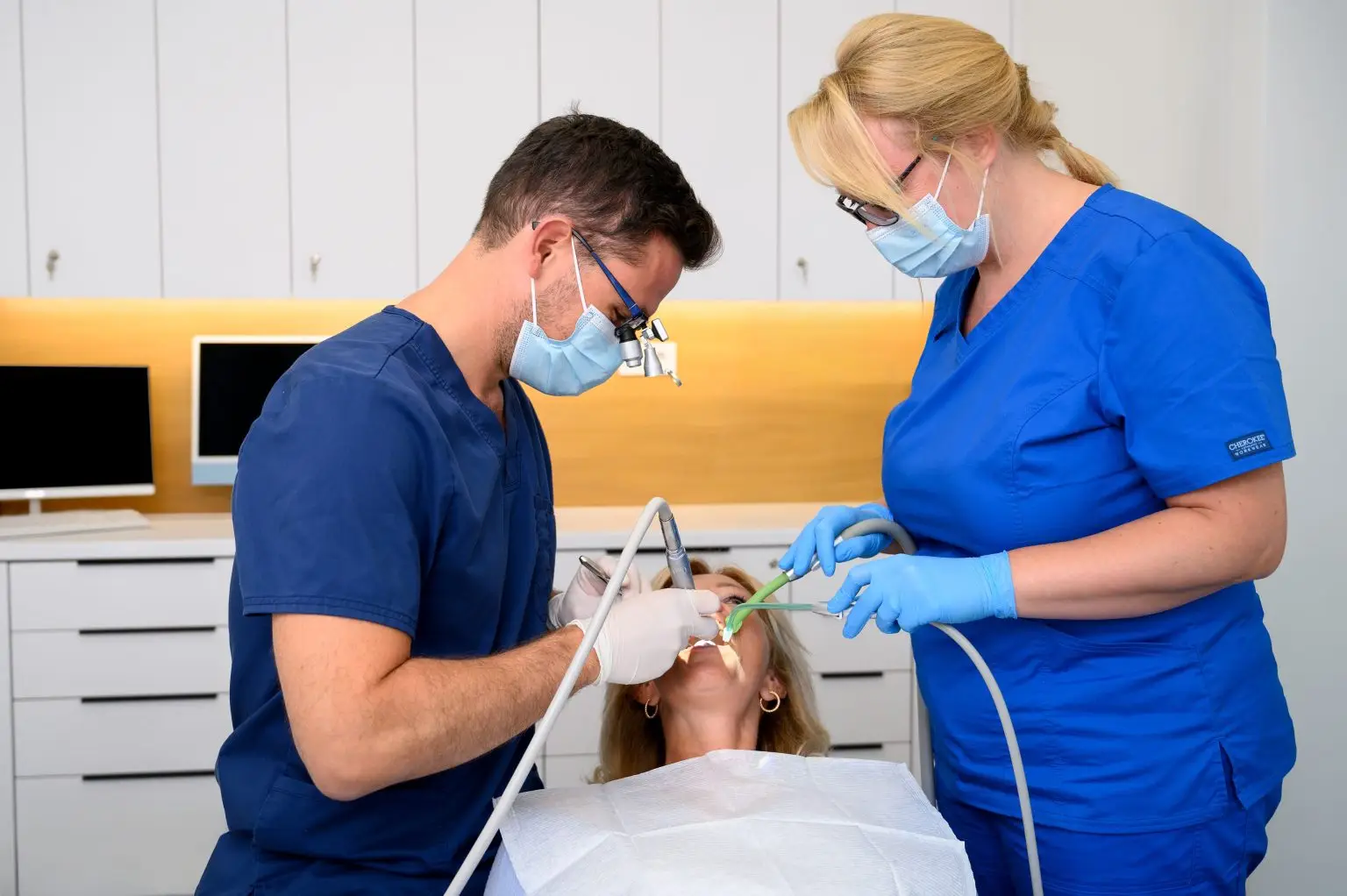
A dentist and an assistant during a biomimetic filling at the PureDental clinic in Budapest
1visit usuallymost fillings are completed in one session
Maximum preservationof your natural tooth structure
Tooth-structure-preserving dentistry · Budapest, District II

Biomimetic filling

A restoration that follows the structure of the natural tooth and preserves as much of it as possible

A biomimetic filling is a modern, precise approach to treatment that preserves tooth structure. Its aim is for the restored tooth to resemble a healthy, natural tooth as closely as possible in appearance, structure and function.

At the PureDental clinic in Budapest's 2nd district we rebuild a damaged or weakened tooth according to biomimetic principles, layer by layer, with a controlled bonding technique. This can be especially important when replacing a large filling, treating a cracked tooth or an old amalgam filling, or any tooth where the aim is to preserve as much of the natural tooth structure as possible.

  • Maximum preservation of natural tooth structure
  • Layered build-up that imitates dentine and enamel separately
  • Can also be an option for large, weakened teeth
  • Painless treatment with modern anaesthesia
1visitusually most biomimetic fillings are completed in one visit
6stepsthe course of treatment from diagnostics to polishing
4principlethe biomimetic approach is based on preserving tooth structure, up to treating cracks
2tissueimitated separately: dentine and enamel
At a glance

In short: when can a biomimetic filling be a good solution?

A biomimetic filling is not simply a "nicer filling". It is a precise restoration technique in which we take into account the natural layers of the tooth, the direction of the chewing forces, the condition of the remaining tooth structure, any cracks, and how the tooth will be loaded in the long term.

The tooth can still be saved
01Can be a good choice

When can it be a good solution?

A biomimetic filling can be a good choice when the tooth can still be saved but it is no longer a simple, small filling. In that case the aim is not only to close the cavity but also to restore the structure, load-bearing capacity and natural function of the tooth.

It may be especially relevant if an old, large filling has to be replaced, the tooth has weakened under an amalgam filling, a piece of the tooth has broken off, a crack is visible, or so much of the tooth is missing that a conventional filling would be a less durable solution. In such cases the biomimetic technique aims to preserve as much natural tooth structure as possible and stabilises the tooth with a layered build-up, a precise bonding technique and, if necessary, fibre-glass reinforcement.
Another treatment may also be considered
02It is not always the best option

When is it not the best option?

It is not the best solution in every case. If too much of the tooth is missing, the crack runs down to the root, or the pulp is already inflamed, an inlay, onlay, crown or root canal treatment may be justified.

We always make the decision on the basis of an examination and, if necessary, an X-ray.

To sum up: if the aim is not only to fill the hole but to restore the tooth in a stable, gentle way with a natural function, a biomimetic filling can be a good solution.

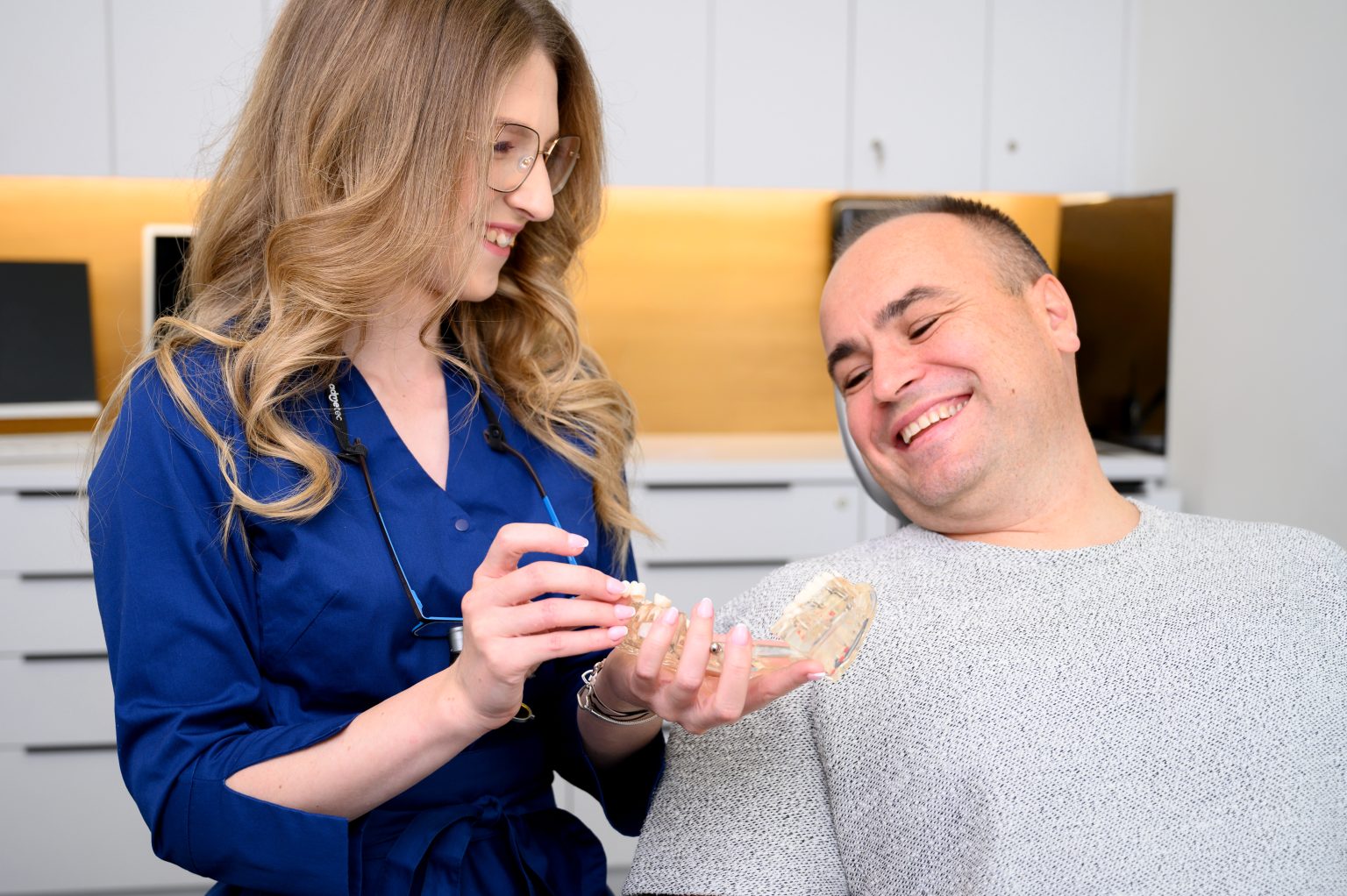
A dentist explains the treatment to a patient with a tooth model at the PureDental clinic
Imitating nature

What is a biomimetic filling?

The word "biomimetics" means imitating nature. The aim of biomimetic dentistry is for the treated tooth to come as close as possible to its original, healthy state in structure, function, load-bearing capacity and aesthetics.

A conventional filling mainly closes the cavity. With a biomimetic filling we aim for more than that: we replace the missing tooth structure in such a way that the tooth and the filling behave as one unit, and the load is distributed during chewing in a way similar to nature. For this, the anatomical shape, the different structure of enamel and dentine, the chewing function and the remaining tooth structure all matter.

A biomimetic filling is therefore not a product, but a complex restoration approach and technical protocol.

Four basic principles

The principles of the biomimetic approach

01

Minimally invasive treatment, that is, preserving natural tooth structure

One of the most important principles of biomimetic dentistry is that we remove only the tooth structure that is decayed, damaged or structurally no longer salvageable. We preserve the healthy enamel and dentine as far as possible. We do not prepare a larger cavity just so that the filling "fits in".

This matters because natural tooth structure is valuable. The elasticity, load-bearing capacity and sensitivity of a natural tooth can only be approximated with artificial materials, never fully copied. The more healthy tooth structure remains, the better the foundation for a long-term restoration.

02

The tooth and the filling work as one unit

The key to biomimetic treatment is the controlled bonding (adhesive) technique. The aim is not only for the filling to stay in place, but for such a strong bond to form between the tooth and the filling material that it also restores the mechanical unity of the tooth.

This is especially important for larger fillings. If the tooth walls are already weakened, a badly planned or improperly bonded filling can strain the tooth further. The aim of the biomimetic technique, by contrast, is to restore the structural unity of the tooth as well as possible.

03

Imitating dentine and enamel separately

A natural tooth is not a homogeneous material. The inner dentine layer of the tooth is more elastic, the outer enamel harder and more wear-resistant. In a biomimetic filling we try to rebuild this dual structure, so we do not fill the cavity with a single material in one block.

In the deeper layers we aim for materials and techniques that support the elasticity and load-distributing role of the dentine. On the surface we shape a form, hardness and anatomy that imitate the natural function of the chewing surface.

04

Treating cracks and structural weaknesses

With a large old filling, an amalgam filling or a cracked tooth, it is not enough to remove only the decayed part. The structural condition of the tooth must also be examined. If cracks run through the dentine, or the tooth walls have weakened, these influence what type of restoration will last.

In a biomimetic filling, cracks, thin tooth walls, decay under an old filling and the bite load therefore also play an important part in the decision.

Comparison

How is it different from a conventional composite filling?

The difference is not in the colour of the material: in both cases we are talking about a tooth-coloured, aesthetic composite restoration. The real difference lies in the treatment philosophy, the preparation, the bonding protocol, the layering, and how much the aim is the complete structural restoration of the tooth.

A conventional composite filling is also a good and durable solution for most small and medium cavities. The biomimetic technique comes to the fore when the tooth is more severely damaged or structurally weakened, or when the aim is to avoid, where possible, solutions that involve greater loss of tooth structure.

You can read more about general aesthetic fillings here.

Swipe the table sideways for the full comparison →

Aspect Conventional composite filling Biomimetic filling
Main aimFunctional and aesthetic sealing of the cavityRestoring the structure and load-bearing capacity of the tooth
Removal of tooth structureTo the extent needed to shape the cavityOnly the decayed part and the part that cannot be kept
Build-upCan be layered, but not along the biomimetic conceptLayered, imitating the properties of dentine and enamel separately
Isolation, bondingImportantA key role, following a strict protocol (rubber dam)
Treating cracksNot necessarily part of itA deliberate part of the treatment
Fibre-glass reinforcementNot typicalFor large cavities, when needed
When is it ideal?Smaller and medium cavitiesLarge, weakened or cracked teeth, or teeth with an old, large filling
When is it recommended?

When is a biomimetic filling recommended?

A biomimetic filling is mainly an option when the tooth can still be saved, but a conventional, simple filling would no longer necessarily provide a stable enough solution. In that case the aim is not only to close the decay, but also to support the weakened structure of the tooth.

It can be especially useful in the following cases:

  • more extensive tooth decay,
  • replacing an old or poorly sealing filling,
  • a damaged, broken or fallen-out filling,
  • replacing an old amalgam filling,
  • a tooth damaged in an accident or by a fracture,
  • a cracked tooth that can still be restored,
  • a tooth that is structurally weakened but can still be saved,
  • a tooth where the aim is to avoid a crown, if this is professionally safe,
  • after root canal treatment, in some cases, as part of the final build-up.

When is a biomimetic filling not enough?

A biomimetic filling is not a universal solution either. Another treatment may be needed if:

  • the pulp (nerve) is already inflamed or dead, so root canal treatment is needed,
  • too much of the tooth is missing for a filling to restore it durably,
  • the decay extends deep below the gum,
  • the tooth can no longer be restored structurally, for example because of a crack running down to the root,
  • because of the bite load an inlay or crown would be a more stable solution.

In such cases an inlay or onlay, a crown or another dental restoration may be the right solution. After root canal treatment, a tooth built up according to biomimetic principles is also often part of the final solution.

The greater the loss of tooth structure, the more important the biomimetic approach becomes. In such cases the aim is not only to close the cavity but also to restore the structural stability of the tooth. In certain cases teeth can be restored this way for which a conventional filling would be less durable, and for which we would earlier have recommended an inlay or a crown.

The course of treatment

How is a biomimetic filling made?

In brief

A biomimetic filling is a precise treatment with several steps. It is usually completed in one visit, but it takes more time than a simple filling, because the bonding, layering, shaping and bite adjustment all receive greater attention.

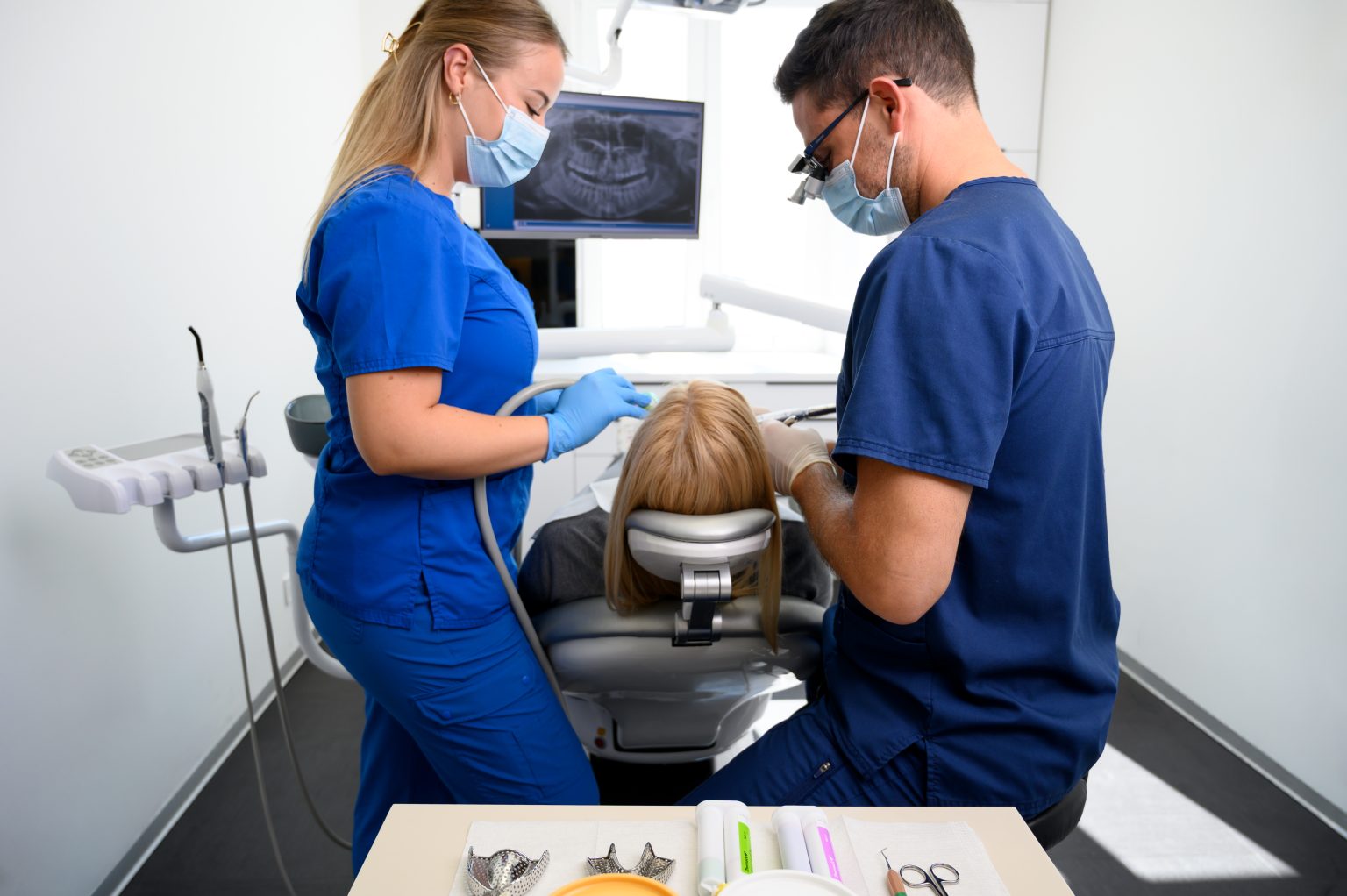
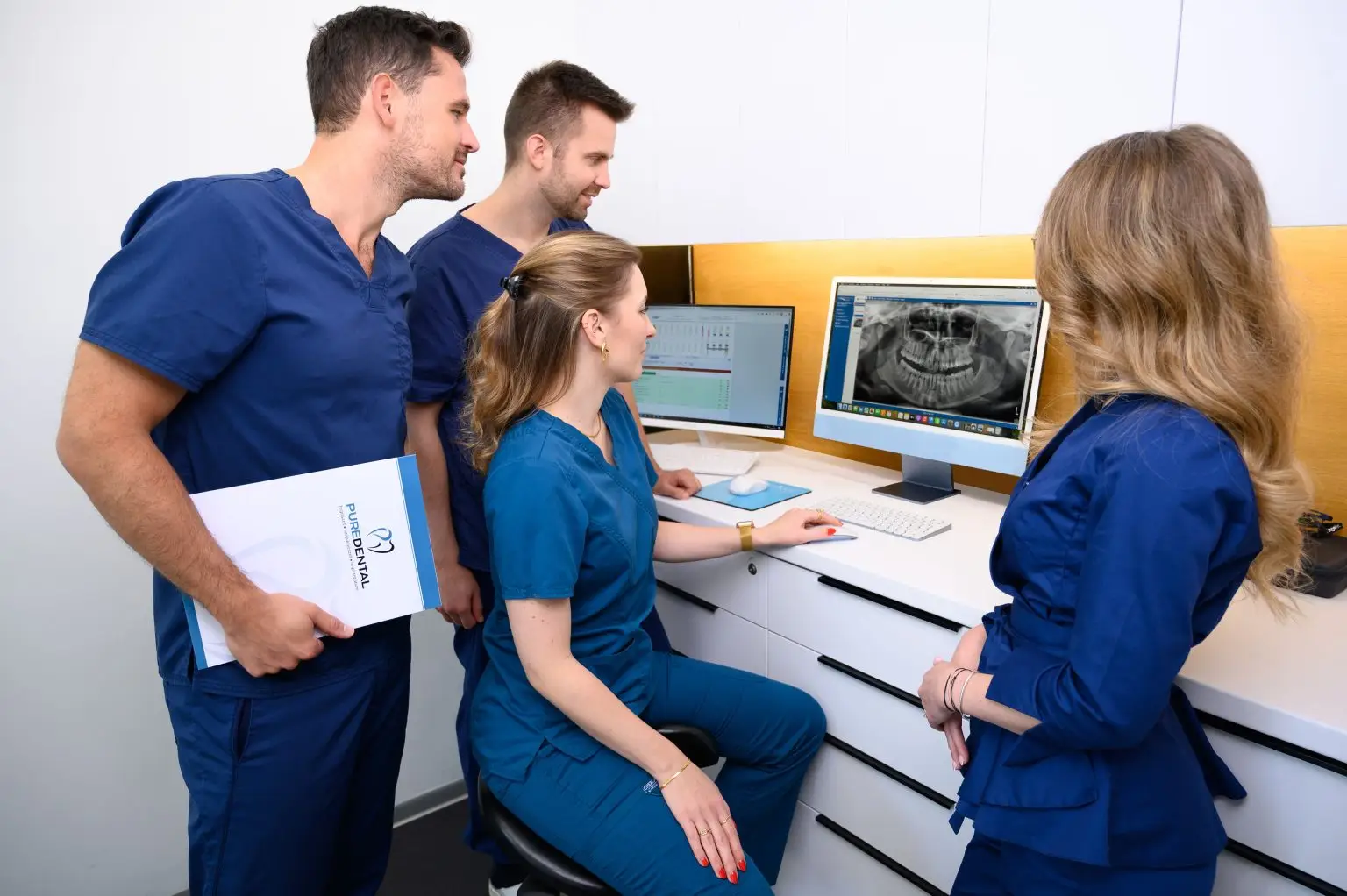
Dentists plan the treatment for a biomimetic filling on the basis of an X-ray
1–3First steps

Examination, isolation and removal of the decayed part

1

1. Diagnostics and assessment

First we examine the tooth, the old filling, the condition of the tooth walls, the gums and the bite. If needed, an X-ray is also taken, so that we can see the depth of the decay, how close it is to the pulp, and whether there is any change that affects the treatment plan.

This is when we decide whether the tooth is suitable for a biomimetic restoration, or whether an inlay, a crown or perhaps root canal treatment is needed instead.

You can read about the dental assessment here.

2

2. Isolation with a rubber dam

An important part of a biomimetic filling is precise isolation. Where possible we use a rubber dam, a thin rubber sheet that separates the tooth being treated from saliva and moisture.

This is important because moisture can significantly reduce the quality of the bond. A rubber dam can also be more comfortable for the patient, because water, filling materials and treatment fluids do not spread around the mouth.

3

3. Removing the decayed tooth structure and cracks

We remove the decayed and structurally weak tooth structure, but keep as much of the healthy part as possible. If we find a crack in the dentine, we treat that too, because the long-term fate of the tooth depends on its structure at least as much as on the decay itself.

The aim is not to prepare as large a cavity as possible, but to remove only as much tooth structure as is professionally necessary.

Making a filling with rubber dam isolation at the PureDental clinic
4–6Build-up

Bonding, layered build-up and shaping

4

4. Adhesive preparation

We prepare the tooth surface according to a special bonding protocol. This step determines how stably the filling material will bond to the tooth.

In the biomimetic approach bonding is not a technical detail but one of the keys to the treatment. A good seal reduces the chance of gaps forming, of secondary decay and of premature failure of the restoration.

5

5. Layered build-up, with fibre-glass reinforcement where needed

We do not build up the composite in one large mass but in several thin layers. This reduces the shrinkage stress that arises when the material sets, and the layered structure of the tooth can also be rebuilt: first we replace the more elastic dentine layer, then the harder enamel layer.

For large cavities or weakened teeth we may also use fibre-glass reinforcement. It helps to distribute the chewing force more evenly, reduces stresses inside the tooth and stabilises the larger filling. It is not necessary in every case; the treating dentist decides whether to use it.

6

6. Anatomical shaping, bite adjustment and polishing

The filling is not made as a "smooth surface". We rebuild the cusps and grooves of the tooth, the contact points with the neighbouring teeth and its original contour. Then we check the bite: if the filling is even slightly too high, the tooth can be overloaded. Finally we finish and polish the surface so that it looks natural, is smooth and is easy to clean.

Filling, inlay or crown?

Biomimetic filling, inlay or crown: which one do you need?

The choice depends mainly on how much healthy tooth structure remains and where the damage is located. The overview below helps you find your way; we make the final decision together on the basis of the examination.

Small or medium cavityStarting situation

Common solution

Aesthetic composite filling

Larger cavity, old large filling, weakened tooth wallStarting situation

Common solution

Biomimetic filling

Greater structural loss, several cusps affectedStarting situation

Common solution

Inlay, onlay or overlay

Severely weakened, root-treated or heavily damaged toothStarting situation

Common solution

Crown

Inflamed or dead pulpStarting situation

Common solution

Root canal treatment is needed first

One advantage of the biomimetic approach is that in borderline cases it often makes a gentler solution possible. Where a crown would earlier have been needed, which would have meant grinding the tooth down all the way round, a larger, reinforced filling is often enough.

This is always an individual decision, however. If the tooth is too weak, cracked or too little tooth structure remains, an inlay or crown can be a more durable and safer solution.

More: Inlay, onlay and overlay dental inserts – PureDental

More: Dental crowns and bridges – PureDental

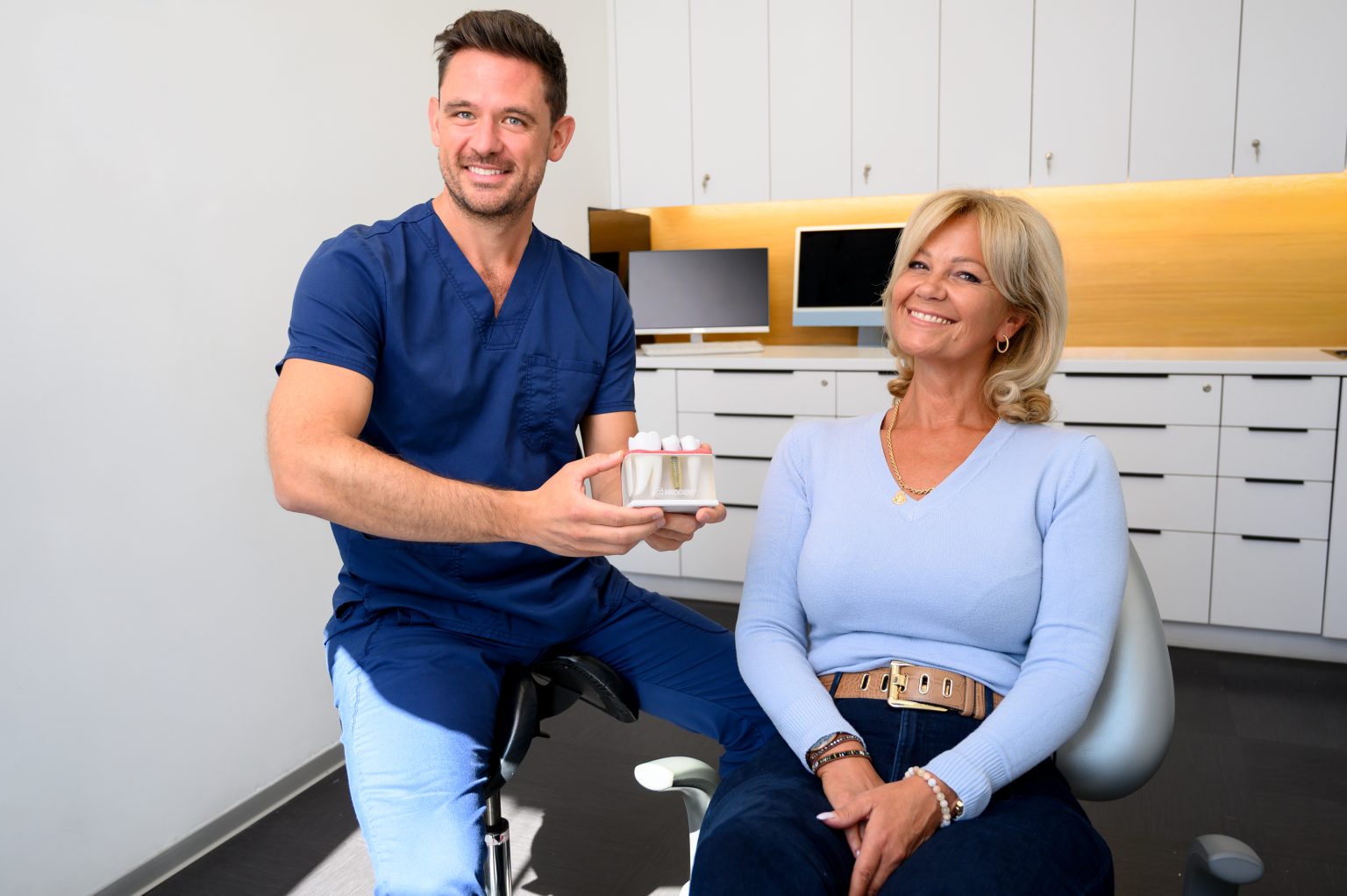
A consultation with the dentist: the treatment option is shown on a tooth model
Advantages

The advantages of a biomimetic filling

The main advantage of a biomimetic filling is that it tries to restore the tooth not only aesthetically but also structurally. It is not the necessary or best solution in every case, but for larger, weakened teeth it can be especially valuable.

01

Preserving natural tooth structure:

as much healthy tooth tissue as possible is kept.

02

Natural function:

it restores not only the shape of the tooth but also its chewing function and load-bearing capacity.

03

Precise, layered technique:

made according to a controlled bonding and layering protocol.

04

An option even for larger damage:

even for teeth where a conventional filling would be less durable.

05

Option of fibre-glass reinforcement:

for the structural stability of the tooth in large cavities.

06

Aesthetic result:

its colour, shape and anatomy follow the natural tooth.

The aim is always for the tooth to stay in function in the long term, and for us to sacrifice only as much tooth structure as is really necessary.

Transparent prices

How much does a biomimetic filling cost?

The price of a biomimetic filling is usually higher than that of a conventional composite filling, because it requires more time, greater precision, stricter isolation, a layered technique and, in some cases, special reinforcement.

Biomimetic filling€360

We give the exact price in a written quote after the examination. This way you can see in advance whether a biomimetic filling is enough, or whether an inlay, onlay or crown is recommended as a more durable solution.

You can find our current prices here: PureDental price list

We accept health fund cards and give our pensioner patients a 10% discount. → Find our price list here

The price is determined mainly by:

  • 01how much tooth structure is missing,
  • 02how many surfaces the filling involves,
  • 03whether an old filling or amalgam filling has to be removed,
  • 04whether there are cracks or weakened tooth walls,
  • 05whether fibre-glass reinforcement is needed,
  • 06whether an X-ray or other diagnostics are needed beforehand,
  • 07whether the restoration can be completed in one visit.

What is the difference between a biomimetic filling and a conventional filling?

Both are made of tooth-coloured composite. A biomimetic filling, however, is made according to a stricter protocol, in several layers, imitating the different properties of dentine and enamel, and places greater emphasis on preserving natural tooth structure and the structural stability of the tooth. This is not about a conventional filling being bad, but about the biomimetic technique being able to give a more durable foundation for large, weakened teeth.

Does a biomimetic filling hurt?

No. We carry out the treatment under local anaesthesia where needed, so you do not feel pain. Thanks to the rubber dam, no water or chemicals get into your mouth during treatment, which many people find more comfortable. After a larger filling, mild sensitivity to cold or biting can occur for a few days.

How many visits does it take?

Most biomimetic fillings are completed in one visit. A session takes longer than with a conventional filling, because it consists of more steps. In the case of very extensive damage, we may divide the treatment into several visits.

How long does a biomimetic filling last?

The lifespan of a filling depends on its size, your oral hygiene, your chewing habits and whether you clench or grind your teeth. With proper care and regular check-ups it can serve for many years. The aim of the biomimetic technique is precisely that the tooth and the filling together should be durable as one unit.

If you clench or grind your teeth at night, it is worth protecting the filling with a night guard.

Can an old amalgam filling be replaced with a biomimetic filling?

Yes. Old amalgam fillings are often large, and the tooth walls around them may have weakened or cracked. During the replacement we remove the amalgam, assess the structure of the tooth and rebuild it according to biomimetic principles. We do not necessarily recommend replacing an intact, well-sealing amalgam filling, however; we decide this together on the basis of the examination.

Is it worth replacing an old filling that is in good condition?

Usually not. With every replacement of a filling a little healthy tooth structure is lost, so if a filling is intact, seals well and has no decay under it, it should not be touched. We recommend replacement if the filling is damaged, seals poorly, has decay under it, or the tooth shows signs of cracking.

What is fibre-glass reinforcement, and is it needed for everyone?

Fibre-glass reinforcement is a thin, strong fibre-glass material that we build into the inside of a filling in large cavities. It helps to distribute the chewing force and to stabilise the weakened tooth. It is not necessary in every case: for smaller and medium cavities it is usually not needed, and the treating dentist decides whether to use it.

Can a cracked tooth also be restored with a biomimetic filling?

In many cases yes, if the crack is in the crown part and does not reach down to the root. During biomimetic treatment we search for the crack, remove it if necessary, and build up the tooth so that the load does not strain it further. If the crack runs to the root, the tooth often can no longer be saved. If you have a sudden, sharp pain when biting, please book an appointment as soon as possible, even as emergency care.

Biomimetic filling or inlay/onlay: which lasts longer?

This depends on the condition of the particular tooth. If enough natural tooth structure remains and the structure of the tooth can be stabilised well, a biomimetic filling can be a gentle and durable solution. If several cusps are missing, the loss of tooth structure is very large, or the chewing load is high, an inlay, onlay or overlay can be the safer solution.

We always make the decision on the basis of an examination.

Consultation

Request an appointment for a consultation!

If you have a large old filling, are thinking of replacing an amalgam filling, have a broken or weakened tooth, or would like to avoid treatments that involve unnecessary loss of tooth structure, it is worth checking whether your tooth is suitable for a biomimetic restoration.

At the PureDental clinic in Budapest's 2nd district we help you decide, with a detailed examination, X-ray diagnostics where needed and a personalised treatment plan, whether a biomimetic filling, an inlay/onlay or another solution would be the best choice.

Find out whether your tooth is suitable for biomimetic restoration. Call now or apply online, and we will contact you within 3 hours during opening hours.

  • Maximum preservation of natural tooth structure
  • Layered build-up that imitates dentine and enamel separately
  • Can also be an option for large, weakened teeth
  • Painless treatment with modern anaesthesia

Biomimetic filling in Budapest's 2nd district: a tooth-structure-preserving, layered, aesthetic restoration for larger, weakened teeth or teeth affected by an old filling.