An invisible, durable solution for restoring decayed and damaged teeth
Tooth decay or a chipped tooth no longer has to mean a permanent aesthetic problem. A filling is usually needed when acid produced by bacteria in the mouth damages the tooth enamel, or when a fracture or chip damages the tooth structure. At PureDental's Budapest clinic, we restore the health, stability and natural beauty of your teeth pain-free, using modern, tooth-coloured composite fillings.

Tooth decay is caused by bacteria living in the mouth, which produce acid from the sugars and carbohydrates in the food we eat. This continuously lowers the pH level in the oral cavity, and the acid gradually dissolves the tooth's hardest, protective layer, the enamel, then - without treatment - reaches the more sensitive dentin layer beneath it, where the process speeds up and typically causes pain. In an advanced state it reaches the inner canal of the tooth, which may require a root canal treatment or tooth extraction.
The job of a filling is to stop this damage: the dentist removes the decayed, softened tooth tissue, then fills the resulting cavity with a tooth-coloured, durable material, restoring the tooth's original shape and chewing function.
The sooner the aesthetic filling is placed, the smaller the surface that needs to be restored, and the simpler, faster and gentler this dental treatment is.

An aesthetic composite filling is the ideal choice for small or medium-sized cavities, or a chipped or broken tooth, when the tooth structure is still stable enough for the filling to provide adequate support in the long term.
A filling is especially recommended if you experience any of the following symptoms:
If you recognise any of these in yourself, it is worth requesting an appointment as soon as possible: early intervention is simpler, gentler and more cost-effective than a more extensive treatment that becomes necessary later.
At PureDental, we work exclusively with modern, tooth-coloured composite filling materials, which represent one of the best solutions currently available, both aesthetically and from a health perspective. The table below will help you understand the different types of filling material.
| Feature | Composite fillingPureDental's choice | Amalgam filling (outdated)Only when replacing |
|---|---|---|
| Appearance | Composite fillingtooth-coloured, unnoticeable | Amalgam filling (outdated)silvery grey, clearly visible |
| Method of bonding | Composite fillinglayered build-up, light-cured to bond with the tooth surface | Amalgam filling (outdated)mechanical retention, does not bond to the tooth surface |
| Loss of tooth structure | Composite fillingminimal | Amalgam filling (outdated)greater, healthy tooth structure must also be removed |
| Mercury content | Composite fillingnone | Amalgam filling (outdated)yes, no longer recommended today |
| Use at PureDental | Composite fillingthe primary material in every case | Amalgam filling (outdated)only encountered when replacing old fillings |
While we no longer work with amalgam fillings, many of our patients still have silvery fillings made previously at another clinic. Their safe removal and replacement with a tooth-coloured composite is a dedicated service of ours, which you can read more about below, in the "Replacing amalgam fillings" section.
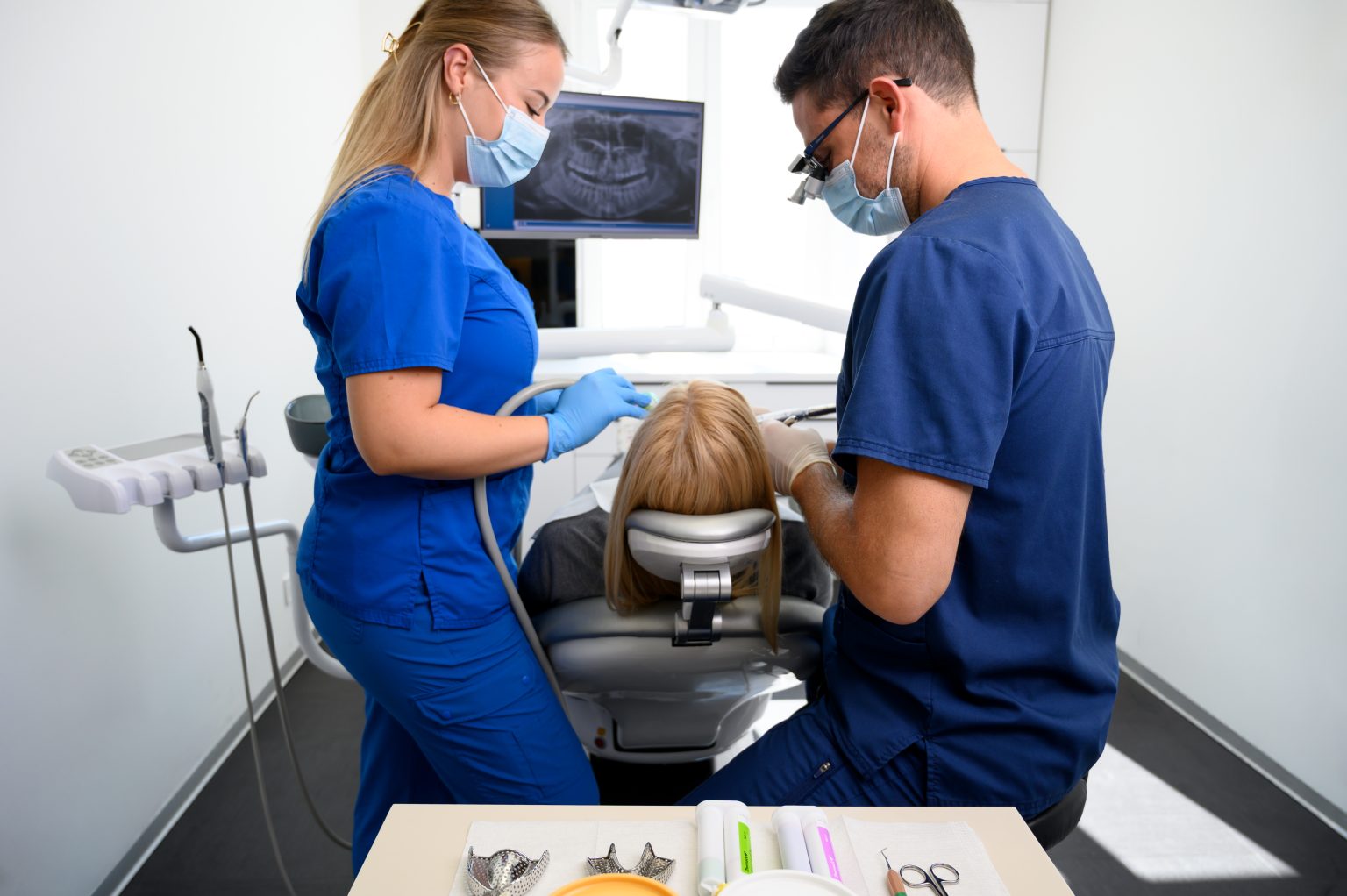
During the filling, the decayed, damaged part of the tooth is precisely removed, and the tooth is then - whenever the clinical situation allows - isolated with a rubber dam. This helps keep the treatment area dry, which is important for a durable, precise filling. The tooth is then built up with tooth-coloured composite material using a layering technique, after which the filling is shaped, checked and polished to a shine. The treatment can be performed pain-free under local anaesthesia, and the end result is an aesthetic, natural-looking filling.

If needed, the treatment begins with local anaesthesia, so the filling can typically be carried out pain-free. Our goal is for the patient to feel comfortable throughout the procedure.
A dry, well-isolated treatment area is one of the key requirements for a precise, durable filling. To achieve this - whenever the clinical situation allows - we use rubber dam isolation. This is a thin, flexible rubber sheet that separates the tooth being treated from saliva, moisture and the rest of the mouth. The rubber dam supports more precise work, improves bonding conditions, and can make the treatment more comfortable and safer.
The dentist precisely removes the damaged, softened tooth tissue, while preserving as much healthy tooth structure as possible. The goal is not only to remove the decayed part, but also to gently preserve the tooth's natural structure.
The cleaned cavity is prepared according to a special bonding protocol, so that the tooth-coloured composite filling material bonds securely to the tooth. This step is especially important for the durability, seal and long-term aesthetic result of the filling.
The cavity is filled in thin layers with modern, tooth-coloured composite material. The layering technique allows the tooth's natural colour, shape and translucency to be reproduced as accurately as possible. This way, the filling can be not only functional but also aesthetically natural-looking.
Each composite layer is hardened with a special LED light. As a result, the filling sets by the end of the treatment, and the tooth becomes usable again within a short time.
As a final step, we check the bite and adjust the filling to the tooth's natural shape. The surface is polished smooth and finished to a shine, so the filling is comfortable, does not interfere with the bite, and feels natural and smooth to the touch.
A natural-looking, aesthetic result. See our patient's before-and-after photo.


The purpose of rubber dam isolation is to separate the tooth being treated from the rest of the mouth, so the work area stays dry, clearly visible and well controlled while the filling is placed. The rubber dam is a thin, flexible rubber sheet that helps keep saliva, moisture and the tongue away from the treatment area.
This is especially important when placing an aesthetic, tooth-coloured composite filling, because modern bonding techniques are sensitive to moisture. If the tooth surface is properly dry and isolated, the filling material can bond more precisely to the tooth, which contributes to the filling's durability and better seal.
The rubber dam can also make the treatment more comfortable for the patient: less water, debris and filling material can get into the mouth, and the tongue and cheek are better protected during the procedure. It cannot be used in every clinical situation, but when possible, it is an important tool for a precise filling.
Placing an aesthetic filling generally takes 30-60 minutes, but the exact time depends on the size and depth of the cavity, the position of the tooth, and the complexity of the filling.
A smaller, simpler filling can be completed in less time, while a larger filling involving several surfaces or in an aesthetically prominent area may require more time. The treatment includes not only removing the decayed part, but also isolating the tooth, bonding preparation, layered build-up, bite check and polishing.
The goal of an aesthetic filling is not only to restore the tooth's function, but also to achieve a natural-looking, comfortable and durable result.
After a tooth-coloured composite filling, the material hardens by the end of the treatment, because each layer is cured with a special LED light. Because of this, the filling itself becomes load-bearing within a short time.
Even so, it is worth waiting until the anaesthetic has completely worn off. While the lip, tongue or cheek are numb, the patient can easily bite the soft tissue by accident. Once the numbness has passed, eating is generally fine, but for the first few hours it is advisable to avoid very hard, sticky or strongly staining foods, especially with a larger or deeper filling.
If the filling feels disturbingly high when biting down, it is not worth waiting for it to "wear in" on its own. In such cases, the filling can be gently adjusted during a short check-up.
We use exclusively class I nano-composite materials, which match the colour of your natural teeth perfectly, so the filling remains completely unnoticeable.
When is an aesthetic filling recommended?
For small and medium-sized cavities, chipped teeth, and for replacing old amalgam fillings.
Benefits
The lifespan of a composite filling depends on several factors: the size of the filling, the load on the tooth, oral hygiene, bite conditions, nighttime teeth grinding, and how regularly the patient attends check-ups.
A well-made, properly cleaned composite filling can last for many years. It is important to know, however, that no filling lasts forever. Over time the edge of the filling may become discoloured, and wear, cracks, marginal gaps or secondary decay can develop next to it. That is why it is worth having it regularly checked to see whether the filling still seals well, is undamaged, and whether new decay has developed in the tooth.
Precise execution, proper isolation, careful polishing, and thorough brushing and interdental cleaning at home all matter a great deal for the long-term result.
A filling can generally be placed pain-free under local anaesthesia. Before the treatment, the dentist numbs the affected area, so the patient may feel at most pressure, vibration or a mild stretching sensation, but no sharp pain.
For a smaller, superficial cavity, anaesthesia may not be necessary, but for deeper decay, anaesthesia is recommended for a comfortable, pain-free treatment. For a few days after the procedure, mild sensitivity to cold, heat or biting may occur, especially with a deeper filling. This is often temporary, but if the pain intensifies, becomes persistent, or the tooth feels high when biting, it is worth coming in for a check-up.
A filling can be the ideal solution for small and medium-sized cavities or loss of tooth structure. There are situations, however, where too much of the tooth's own structure is already missing, and a conventional filling would not provide a stable enough, long-term safe solution.
An inlay, such as an inlay or onlay, may be an option when the tooth damage is more extensive, but there is still enough of the tooth's own structure left that it does not need to be covered with a full crown. The inlay is a precisely fitted restoration made in a dental laboratory or with a digital process, which can provide a stronger, more stable solution for larger chewing-surface defects.
A crown may be justified when the tooth is significantly weakened, a large part of it is missing, it is broken, root-canal treated, or the remaining tooth structure could no longer safely hold a filling or inlay. In this case, the crown surrounds and protects the tooth while restoring its chewing function and appearance.
The decision is always based on an individual examination. The dentist recommends the safest solution based on the size of the decay, the condition of the tooth, the bite, aesthetic needs and long-term stability.
Many of our patients come to us wanting to replace the noticeable silvery-grey amalgam fillings made previously at another clinic with a tooth-coloured, aesthetic solution.
the dark, metallic colour of amalgam clearly stands out against the natural tooth colour, especially when smiling.
over the years, the edge of an amalgam filling can crack, and decay can start again underneath it.
modern composite technology allows us to preserve as much healthy tooth structure as possible during the replacement.

The dentist removes the old amalgam filling in a controlled way, then examines the resulting cavity for any hidden decay underneath it. If necessary, the damaged parts are removed, and the cavity is then filled with a tooth-coloured composite using a layering technique - just as with a new filling.
The exact price of a filling always depends on the extent of the decay, the number of tooth surfaces involved, and any prior treatment needed (such as removing an amalgam filling). At the consultation, we always provide a written price quote, with no hidden costs.
Indicative prices: aesthetic filling under small magnification, small EUR 128, large EUR 145. We provide the exact price in a written quote after the examination.
→ You can find our detailed price list here: puredental.hu/en/prices/

If the extent of the decay or fracture exceeds what a conventional filling can safely and durably restore - meaning a significant part of the tooth is missing, or the remaining tooth wall would no longer provide enough stability - a dental inlay is the more durable, safer solution. The inlay is custom-made in a dental laboratory, so it can withstand greater load than a filling made directly in the chair.
If you are not sure whether a filling or an inlay is the right solution in your case, we will help you decide at a consultation. You can read more about inlay treatment here: Inlay, onlay and overlay dental restorations - PureDental
We have collected the questions our patients ask most often about fillings.
 Medically reviewed by Dr. Júlia Molnár Prosthodontist, digital dentistry, conservative dentistry
For small and medium-sized cavities, chipped or broken teeth, and for replacing old amalgam fillings. For more extensive damage, an inlay is the recommended solution instead.
A composite filling is tooth-coloured and completely unnoticeable, requires less healthy tooth structure to be removed, and contains no mercury. It is also completed in a single visit and bonds chemically to the tooth surface.
With proper oral care and regular dental check-ups, a well-made composite filling lasts 8-10 years, and often even longer.
No, the treatment is completely pain-free thanks to modern local anaesthesia. Once the anaesthetic wears off, mild, temporary sensitivity may occur.
Yes, we safely remove old amalgam fillings and replace them with a tooth-coloured, natural-looking composite.
The composite filling is immediately, fully load-bearing once it has been light-cured. The anaesthetic, however, can last 1-3 hours, so it is advisable to wait with eating until then, to avoid biting your numb lip or tongue.
The price of a filling depends on the extent of the damage and the number of tooth surfaces involved. We provide a written price quote at the consultation. Detailed prices are in the "Filling prices in Budapest" section above.
With proper oral hygiene and regular dental check-ups, a well-made composite filling keeps its function and appearance for 8-10 years on average, and often even longer.
Aesthetic fillings at PureDental! Book an appointment, and we will help you decide whether an aesthetic filling or an inlay is the best solution for you. Call now, or apply online, and we will contact you within 3 hours during opening hours.