Recurring pain or gum inflammation.
If the wisdom tooth has only partly erupted, an area that is hard to clean can form under the gum that partly covers its crown. This can cause recurring inflammation, known as pericoronitis.


Wisdom tooth removal at PureDental is performed by an oral surgery specialist. We plan the procedure on the basis of a clinical examination, a panoramic X-ray or a CBCT scan. In a simple case, removing a wisdom tooth can take about 15 minutes; in a more complex operation it can take 30-35 minutes or longer.
The treatment is usually done under local anesthesia, but where justified it can also be carried out under sedation or general anesthesia.
The price starts from €135. Our clinic is in the 2nd district, at Margit körút 3.

Removing a wisdom tooth may become justified if it causes pain, recurring inflammation, decay or another change, or if it endangers the health of the neighboring teeth.
Not every wisdom tooth has to be removed. A wisdom tooth without complaints and without any sign of disease can often be kept and checked regularly. In making the decision we assess the complaints, the result of the clinical examination, the position of the tooth and, where needed, the X-ray together.
If the wisdom tooth has only partly erupted, an area that is hard to clean can form under the gum that partly covers its crown. This can cause recurring inflammation, known as pericoronitis.
Food and plaque that regularly get trapped can cause inflammation, bad breath and decay.
The position at the back of the mouth can make cleaning and dental restoration more difficult. An untreated tooth can become inflamed, and the inflammation can spread to the neighboring teeth. If the tooth cannot be treated properly, removal may be justified.
A tilted wisdom tooth can contribute to decay on the back surface of the second molar, to damage of its supporting tissues or, more rarely, to root resorption.
Around an unerupted wisdom tooth, a cyst or another change can in some cases develop, which requires further examination and, if needed, surgical treatment.
It can cause crowding or shifting in the dental arch. In addition, in some orthodontic treatments removing the wisdom tooth may be justified, for example if it gets in the way of the planned tooth movement. However, preventing later crowding of the lower front teeth is not, on its own, enough reason for routine removal.
In certain treatment plans the position of the wisdom tooth can get in the way of the planned treatment, so removing it may become necessary.
If the wisdom tooth has erupted properly, is easy to clean and healthy, and does not endanger the surrounding teeth, it usually does not need to be removed.
For wisdom teeth that lie completely in the bone and cause no complaints, the expected benefits and risks of surgery also have to be weighed. If there is no change that justifies removal, regular dental check-ups can be the right solution.
We decide individually whether check-ups are needed and how often. We take an X-ray when the clinical situation or the follow-up justifies it.
Pain around the wisdom tooth, swollen or red gums, bad breath, difficult cleaning and recurring food build-up can all point to a problem.
There may also be difficulty opening the mouth, tenderness when biting or swelling of the face. With a fever, rapidly increasing swelling, or difficulty swallowing or breathing, urgent care is needed.
Depending on the position of the tooth, how far it has erupted and the anatomy of its roots, removing a wisdom tooth can be a simple or a more complex oral surgery procedure.
The PureDental price list distinguishes three categories of removal. We determine the right category during the examination, based on the expected procedure.
Simple removal is possible if the tooth has erupted properly, is accessible, and the position of the roots allows extraction without a surgical opening.
We remove the tooth with forceps, an elevator or another extraction instrument. In a favorable case the procedure can take about 15 minutes, but the duration varies from person to person.
Routine antibiotic treatment is usually not necessary.
Complicated removal may be needed if the roots are long, curved or divergent, or if the crown of the tooth is damaged and it cannot be removed safely with the simple method.
In this case, where needed, we divide the crown or the roots of the tooth into several parts and remove each part separately. This can make it possible to preserve as much of the surrounding bone as possible.
The procedure often takes about 20-25 minutes, but it can be longer in a more complex case. We use antibiotics only on the basis of an individual medical indication.
Surgical removal may become necessary if the wisdom tooth lies partly or completely under the gum or the bone and cannot be removed without an opening.
During the operation we open the gum, remove a small amount of bone if needed, and lift out the tooth in several pieces. The wound is usually closed with stitches.
Such a procedure can take about 30-35 minutes or even longer. The surgical opening alone does not make antibiotics mandatory. The treating doctor decides on this based on the risk of infection, general health and the circumstances of the operation.
Scroll sideways to see the full table
| Type | When | Duration | Antibiotics | Price |
|---|---|---|---|---|
| Simple extraction | Erupted, easily accessible tooth | approx. 15 min | usually not | €135 |
| Complicated, with root separation | Usually a visible crown. Tooth with complex root anatomy or difficult access | approx. 20-25 min | in some cases | €161 |
| Surgical, with an opening | Tooth lying partly or completely in the bone | approx. 30-35 min | usually yes | €193 |
The price of wisdom tooth removal is between €135 and €193 per tooth, depending on how difficult the procedure is.
We determine the exact price on the basis of the examination and the necessary diagnostics. Before the operation we give you a written treatment plan and quote, so you know in advance what procedure and costs to expect.
The fee for imaging examinations and for sedation or general anesthesia may appear as a separate item in the quote where needed.

At PureDental we offer an additional service package linked to wisdom tooth removal, which supports your preparation, your healing after the operation and the later check-up.
To support your recovery, we would like to treat you to a comprehensive gift package.
*Discounts cannot be combined.
The cost of wisdom tooth removal may also be eligible for reimbursement by Hungarian health funds. PureDental works with the health funds listed on its website; you can find the details in our health fund information.
The fee for the treatments can be paid in cash, by bank card or by advance bank transfer.
For our senior patients we offer a discount in line with the current terms of the 10% senior discount.
*Discounts cannot be combined.
Our full price list: PureDental price list.
At PureDental, wisdom tooth removal is preceded and complemented by careful planning, suitable anesthesia and personalized aftercare. The treatment consists of six main steps.
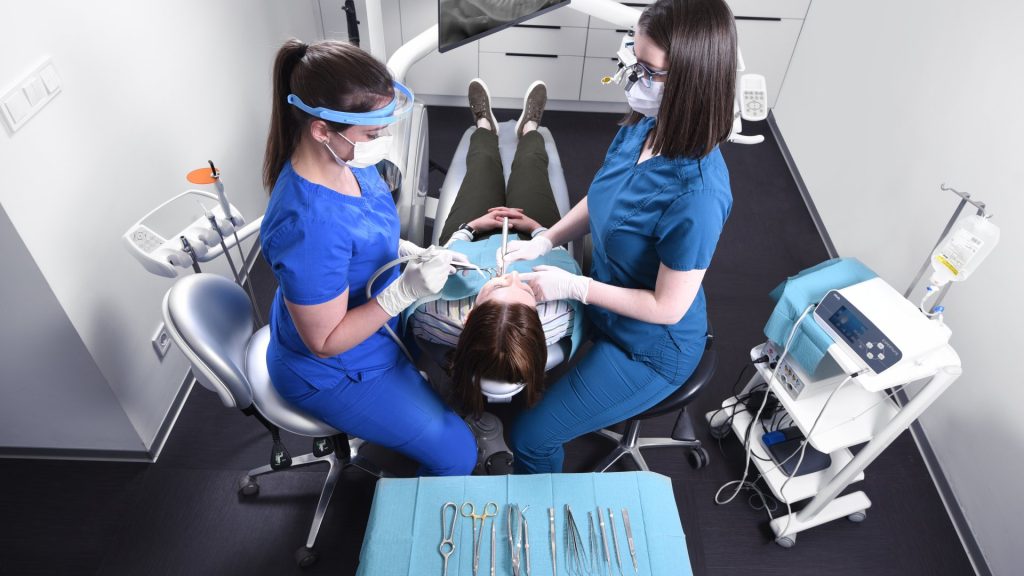
At the consultation we examine the wisdom tooth, the surrounding gum and the neighboring teeth, then go through your complaints and the possible treatment options.
If imaging is needed, a panoramic X-ray is often enough at first. We recommend a CBCT scan if the two-dimensional X-ray does not give enough information, for example to assess the relationship to the lower jaw nerve, and the three-dimensional image can influence the surgical decision.
On the basis of the examination we determine whether a simple, complicated or open (surgical) removal is needed.
Before the operation we explain the course of the procedure, its expected duration, the possible risks and what to know about healing. You also receive the quote in writing.
Wisdom tooth removal is usually done under local anesthesia. The aim is that you do not feel sharp pain during the operation; you may, however, feel pressure and movement.
In the case of strong anxiety, the simultaneous removal of several teeth or a more complex operation, sedation or general anesthesia may also be considered, with the appropriate anesthesiology preparation.
Details: Anesthesia and sedation.
We perform the removal with a technique adapted to the position of the tooth and its root anatomy. In a simple case the tooth can be removed without an opening. In a complicated or surgical case, the gum may be opened, the tooth divided into parts and, where needed, a small amount of bone removed.
In many cases the procedure can be done in 15-35 minutes, but removing complex, deeply lying or anatomically unfavorable wisdom teeth can also take longer.
After the tooth is removed, we check the socket and clean it if needed, then close the wound with stitches where justified.
We give you written instructions on wound care, eating, oral hygiene and pain relief. We prescribe antibiotics not routinely, but on the basis of an individual medical indication.
Where needed and on medical advice, we can also use Safe Laser soft laser supplementary treatment to support recovery from post-operative complaints and the healing process.
After the operation we arrange a check-up as needed. At PureDental we also use absorbable sutures, whose absorption time depends on the material and on healing.
If the stitch is bothersome, or checking the wound calls for it, we usually remove the stitch after 7-10 days, free of charge.
As part of the discount package we also provide a first-year check-up. At that visit we take a panoramic X-ray only if there is a professional reason for it.
An impacted, that is wedged, wisdom tooth cannot erupt properly because the gum, the bone or the neighboring tooth is in its way. The tooth stays partly or completely in the bone. Removing it is usually a surgical procedure with an opening. A CBCT scan shows the exact position of the roots and the nerve, so the operation can be planned more safely.
A horizontal wisdom tooth lies flat or strongly tilted, often leaning against the neighboring second molar. Food easily gets trapped between them, which puts the second molar at risk of decay as well. Removal is mostly of the complicated or surgical type, with the tooth divided into pieces. CBCT helps decide from which direction the tooth is best lifted out. We also check the condition of the second molar.
With a partly erupted wisdom tooth, part of the crown is visible and the rest is covered by gum. The pocket between the tooth and the gum is hard to clean, so recurring gum inflammation (pericoronitis) can develop. First we treat the inflammation, then we remove the tooth as planned. The type depends on the position of the tooth; it can be simple or complicated.
With an inflamed wisdom tooth it is usually not advisable to extract the tooth immediately, because anesthesia works less well in inflamed tissue and the chance of complications increases. First we treat the inflammation, then the planned removal follows. Once the inflammation has eased, the procedure can be done in calmer conditions and with lower risk. In case of acute pain we aim to provide care out of turn, even on the same day.
If the crown of the wisdom tooth is broken or heavily decayed, the tooth often cannot be saved, because it is hard to treat at the back. A decayed wisdom tooth can rarely be saved, because there is not enough room and visibility to treat it. Removing the remaining part of the tooth can be simple or complicated, depending on the number and position of the roots. CBCT shows how many roots remain in the bone and how close the nerve is.
The bone of the lower jaw is usually denser, and the roots of the lower wisdom teeth can lie close to the nerve canal of the lower jaw.
Removing lower wisdom teeth that lie partly or completely in the bone more often requires an opening, dividing the tooth or removing a small amount of bone.
When planning the operation we pay special attention to how close the nerve is. If, based on the panoramic X-ray, the risk of injury is increased and the three-dimensional information can influence the treatment plan, we may recommend a CBCT examination.
The bone of the upper jaw is usually less dense, so removing upper wisdom teeth can in many cases be simpler.
However, the roots of the upper wisdom teeth can lie close to the maxillary sinus. In rare cases a connection can form between the oral cavity and the sinus when the tooth is removed.
In such a case, depending on the size of the opening, suitable wound care or surgical closure, as well as special post-operative instructions, may be needed.
Scroll sideways to see the full table
| Aspect | Lower wisdom tooth | Upper wisdom tooth |
|---|---|---|
| Bone | harder, denser | looser |
| Nearby structure | lower jaw nerve | maxillary sinus |
| Typical type | more often 2nd or 3rd | more often 1st or 2nd |
| Healing | After surgical cases, stronger swelling and difficulty opening the mouth may occur. 7-10 days | After a simple removal there are often fewer complaints, but this depends on the case |
If you are very afraid, are anxious about the procedure, or several teeth have to be removed at once, sedation or general anesthesia can be chosen in addition to local anesthesia. Both are carried out by a separate anesthesiologist. The decision depends on how difficult the tooth is, on your fear and on your health; we discuss it together at the consultation.
In conscious sedation we reduce anxiety with medication and create a calmer, more relaxed state. The patient usually keeps breathing on their own, and, depending on the depth of sedation, contact can be maintained.
The procedure is complemented by local anesthesia. We monitor the vital signs continuously during the treatment.
The rules on eating and drinking before sedation must always be followed according to the anesthesiologist's instructions. These can depend on the chosen sedation method and on individual health, so it is not enough to rely on a general two-hour fasting rule.
After the treatment an escort is required, and you may not drive for the period set by the doctor.
The fee for conscious sedation is €321 for the first hour and €135 for each additional started hour.
The advantage of this is that the patient does not have to go through several separate operations and healing periods. However, removing four teeth at once can mean a greater surgical burden, so it is not the best solution in every case.
The duration depends on the position of the teeth and the difficulty of the removal. The procedure can take about two hours, but it can also be shorter or longer.
General anesthesia is preceded by an anesthesiology consultation and, as needed, preliminary examinations. You must arrive for the operation fasting, according to the prescribed rules, and with an escort.
The fee for general anesthesia is €725 for the first hour and €387 for each additional started hour.
Details and preparation: Anesthesia, sedation.

The pace of healing depends on the position of the tooth, the complexity of the operation, the patient's general health and how well the post-operative instructions are followed.
Scroll sideways to see the full table
| Period | What to expect |
|---|---|
| The first 24 hours | A blood clot forms in the tooth socket. Slight oozing of blood, tenderness and the beginning of swelling can occur. |
| Days 2-3 | The swelling peaks, then the pain gradually eases. |
| Days 7-10 | If you wish, this is when we remove the stitches, free of charge. The swelling and pain decrease significantly. |
| Weeks 4-6 | The absorbable stitches dissolve and the soft tissue heals. |
| 3-6 months | The remodeling of the bone and the re-ossification of the tooth socket take about this long. |
| 1 year | As part of the discount package a first-year check-up is available; an X-ray is taken for clinical reasons. |
How soon you can return to work depends on the type of procedure and the nature of your work.
After a simple removal many people can resume lighter daily activities within a short time. After an operation with an opening, it is usually worth planning a few days of rest, especially if you do physical work.
After sedation or general anesthesia further restrictions apply, which the anesthesiologist will explain in detail.
Contact our clinic as soon as possible, or emergency care if needed, if:
In case of difficulty breathing or rapidly spreading, severe swelling of the neck and face, call 112 immediately.
Wisdom tooth removal is a frequently performed oral surgery procedure, but like any operation it can carry risks. Accurate diagnostics, the right surgical technique and following the post-operative instructions can help reduce the chance of complications.
Scroll sideways to see the full table
| Complication | What it means | How we prevent it |
|---|---|---|
| Swelling and pain | A natural reaction in the first days after the operation, strongest on days 2-3. | Gentle surgical technique. Cooling, the pain relief recommended by the doctor, rest. Safe Laser on medical advice. |
| Dry socket (alveolitis) | The blood clot of the wound falls out, the bone is exposed and severe pain occurs. | Avoid rinsing, smoking and drinking through a straw in the first days. If you have complaints, get dental care as soon as possible. |
| Temporary numbness | Numbness of the lip, chin or tongue, mostly due to temporary nerve irritation. | With CBCT we assess the position of the nerve and plan the operation accordingly. |
| Opening into the maxillary sinus | With an upper tooth the root can be near the sinus, and the sinus may be opened. | Planning, closing the opening where needed, and special instructions. |
| Post-operative bleeding | The wound bleeds longer than expected or repeatedly. | Taking the medication history, biting on gauze, a stitch where needed. |
| Wound infection | Inflammation, swelling, pus, fever. | Sterile conditions, antibiotics where needed, check-up. |

In wisdom tooth removal at PureDental we focus on accurate diagnostics, protecting the tooth and the surrounding anatomical structures, suitable anesthesia and personalized aftercare.
Our aim is that before the procedure you understand exactly why the treatment is needed, how it works, what risks it may carry and what to expect during healing.
At our clinic panoramic X-ray and 3D CBCT diagnostics are available on site. We use CBCT if a three-dimensional image can give further information that matters for the surgical plan, for example about the relationship between the nerve canal and the roots.
At PureDental we perform about 800-1,000 wisdom tooth removals a year.
Before the procedure you already get an accurate picture of the process and its steps, of healing and of the costs. You receive the written quote before the operation.
We provide full aftercare with written instructions, regular check-ups and continuous availability by phone throughout your whole recovery. After full recovery we welcome you back for a free first-year check-up with a panoramic X-ray, to make sure the recovery was successful.
We are open Monday to Thursday until 8 pm and on Friday until 6 pm, so you can come after work.
On medical advice we also use Safe Laser (soft laser) treatment to support healing. In some cases, photobiomodulation can help reduce post-operative pain and swelling and support the healing process. It does not, however, replace proper surgical care, medication or following the instructions.

Graduated from the Faculty of Dentistry of Semmelweis University, then worked at the Department of Oro-Maxillofacial Surgery and Stomatology of Semmelweis University, where Hungarian and international dental students were also taught.
Areas of expertise include dentoalveolar surgical procedures, implantology and bone grafting operations.
View profile - Dr. Nóra Boka
Degree: 2009, specialist exam: 2012, Master Clinician of Implant Dentistry: 2018.
The work places particular emphasis on treating gum disease, preserving natural teeth and care with an implantology mindset.
View profile - Dr. Gabriella WesselényiWe have collected the questions our patients most often ask before and after wisdom tooth removal.
Wisdom tooth removal under local anesthesia does not hurt; during the procedure you feel only pressure and pulling. We use modern anesthesia and gentle techniques, but afterwards you should expect pain and swelling for a few days. This can be managed with the recommended pain relief. If you are very afraid, sedation or general anesthesia can also be requested.
Removing a wisdom tooth takes 15-35 minutes depending on the type of tooth: about 15 minutes for a simple one, 20-25 for a complicated one, 30-35 for a surgical one. Under general anesthesia, removing all four teeth takes about 2 hours. The total time spent at the clinic is longer, including waiting for the anesthesia to take effect and the instructions.
Wisdom tooth removal costs between €135 and €193 per tooth: €135 for a simple one, €161 for a complicated one, €193 for a surgical one. In addition there may be the specialist consultation (€50), a panoramic X-ray (€38) or CBCT scan (€89), and the fee for sedation or general anesthesia. Prices: 2026 price list.
No, only if it causes complaints or complications. If there are no complaints, regular X-ray check-ups are recommended. A painless tooth can also cause hidden problems, for example a cyst or decay of the second molar, which the X-ray reveals. That is why periodic check-ups are important even if the tooth does not hurt.
There is no mandatory age; a wisdom tooth is worth removing if it causes complaints or endangers the surrounding teeth. If removal is justified, the Hungarian literature considers late adolescence and young adulthood (approx. 16-23 years) ideal, and the frequency of complications grows with age. Sources (in Hungarian): Fogorvosi Szemle 2019, Papp et al., 2020.
Yes, a wisdom tooth can also be removed after 40 if removal is justified. At an older age the bone is denser, so the procedure can be more difficult and healing longer. That is why CBCT-based planning and individual assessment are necessary. For a tooth without complaints, regular check-ups may also be enough.
All four wisdom teeth can be removed in a single session, if general health and the circumstances of the operation allow it.
Simultaneous removal can be considered under local anesthesia, sedation or general anesthesia, but we choose the right method individually.
In making the decision we also take into account the position of the teeth, the expected surgical burden and the healing period.
Yes, in some cases the extraction can be done even with inflammation.
The timing of the treatment is determined by the severity of the inflammation, how far the mouth can be opened, the general condition and the feasibility of the operation.
In the case of milder local inflammation, removal can even be part of the acute care. With more severe inflammation, preliminary local treatment, opening of an abscess or another emergency procedure may be needed.
In case of acute pain we aim to provide care out of turn, even on the same day.
Whether antibiotics are needed after the operation depends on the type of procedure. After a simple removal they are usually not necessary, in a complicated case sometimes, and after a surgical removal with an opening usually yes. The doctor always decides individually, so take antibiotics only on their recommendation and finish the prescribed course.
How soon you can return to work depends on the type of procedure and the nature of your work. After a surgical removal and general anesthesia more rest is needed than after a simple extraction. The swelling is usually greatest on days 2-3, so in the first days it is worth resting without strain.
The package includes the general dental assessment, anesthesia, post-operative information, the aftercare package to support recovery, aftercare and suture removal, as well as the first-year check-up with a panoramic X-ray. The aim of the package is that your recovery stays supported after the procedure, and that we accompany you until the first-year check-up.
Wisdom tooth removal can be a treatment eligible for reimbursement by a health fund.
On the PureDental website you can find the cooperating health funds and what to know about reimbursement.
PureDental has contracts with 9 Hungarian health funds, including OTP, MKB, Allianz, Generali and Prémium. You can find the current list on the Health funds page; if yours is not on it, please get in touch.
Yes, you can request an oral surgery consultation before the procedure. We examine your teeth, look at the X-ray, and give you a written treatment plan and quote. The fee for the specialist consultation is €50 according to the price list. This helps decide whether the procedure is needed and which type is applicable.
Is your wisdom tooth painful, inflamed, only partly erupted or growing at an angle? At PureDental oral surgery, experienced specialists and a detailed examination help you decide whether removal is necessary and which procedure can be the right solution.
With modern diagnostics, local anesthesia, the option of sedation or general anesthesia where needed, and personalized aftercare, we aim for gentle and predictable treatment.
Our experienced oral surgeons help you with modern diagnostics and gentle methods.
Call us now, or apply online and we will contact you within 3 hours during opening hours.
Professional reviewer: Dr. Nóra Boka, dentoalveolar surgeon, implantologist. Dr. Nóra Boka is a dental and jaw surgeon and implantologist with extensive experience in oral surgery, bone grafting procedures, aesthetic soft tissue surgery and periodontology.